
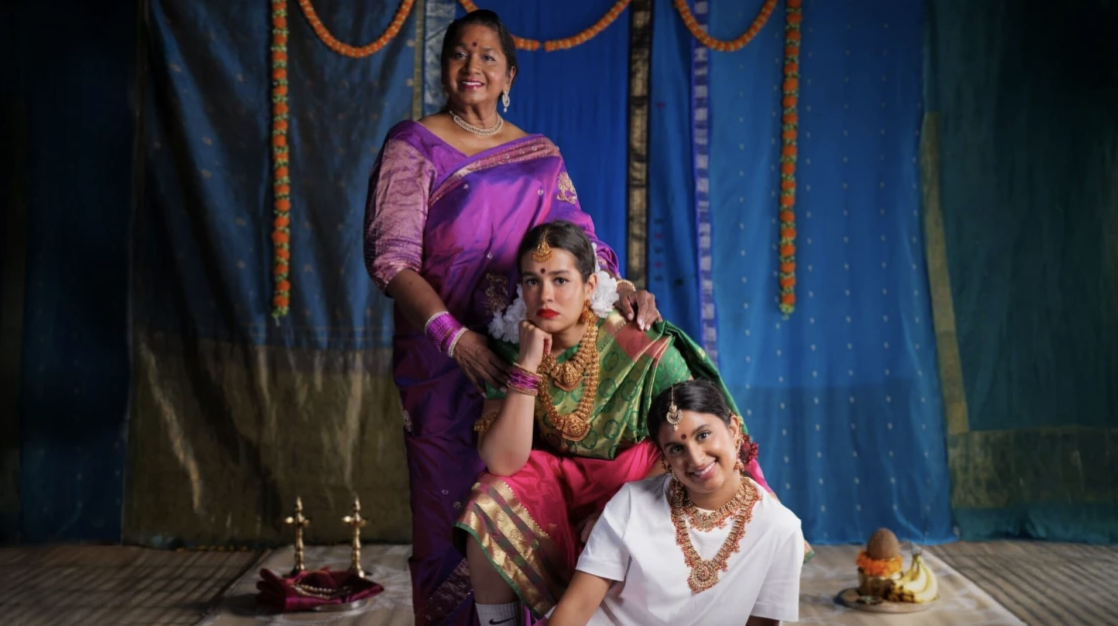
This autumn, writer Laurisa Sastoque joined a Writing Our Legacy network gathering trip to see Period Parrrty, a debut play by Gayathiri Kamalakanthan at Soho Theatre, London. Laurisa’s review is a Writing Our Legacy Creative Commission.
Warning: This review contains spoilers.
On the rainy London evening that I had the pleasure of seeing Period Parrrty, a sizeable audience gathered at the intimate Soho Theatre. I think not many of us imagined that, by the end of the narrative, we’d become part of a gathering connected by multilingual laughter and the shedding of intergenerational pain.
Period Parrrty tells the story of Krish, a non-binary teenager who is soon to celebrate their Samathiya Veedu, a gathering marking their first menstrual period. Alongside their best friend Brenavee, Krish grapples with the challenge of conveying their identity to their mother. The period party holds a dear place in Krish’s mother Brintha’s heart. She spends her days curating Krish’s outfit and finishing preparations. For Brintha, the period party is crucial to Krish’s future and a celebration of their Tamil heritage. Krish feels differently. The whole celebration is an anxiety-inducing reminder that Krish’s identity ‘does not exist in their [Tamil] language.’ As the evocative – and ingeniously sound-engineered – moment when Brintha places a white veil over Krish’s head reminds us, Krish fears that their period party will snowball into a life that they do not want for themselves.
The conflict that Krish faces is raw. It challenges the character beyond their years, and Elizabeth Green’s performance imprints their emotional dilemma on the audience. At the play’s climax, and particularly when Krish leaves their home for a young writer’s retreat in Edinburgh, I feared that Krish would be forced to cut ties or undergo the difficult bifurcation of the self that assails many queer individuals, particularly those belonging to postcolonial cultures.
Yet, Period Parrrty ends on a hopeful and fascinating note. At the end, Krish turns towards the audience and addresses the space that holds us together. They allow themselves to dream of a time and place where they can ’have it all.’
I left the theatre with this phrase replaying in the back of my head. What could it mean to ‘have it all’?
As the play reaches its resolution, conflict sits beyond our view. We see Brintha and Krish’s heartfelt confession in the ‘I talk, now you talk’ scene, where cross-generational struggle builds common ground with a candidness reminiscent of Fawzia Mirza’s The Queen of My Dreams. Krish and Brenavee’s relationship blossoms into the young queer romance that Gurinder Chadha’s Bend It Like Beckham could not be. Krish’s queer Tamil networks expand, and they learn words such as குயர் (queer, pronounced kuyar), which help reconcile different spheres of their being.
But a lot is left unsaid. We know that perhaps Brintha and Krish’s relationship might be one of silent understanding. From Brintha’s endearing yet uncomfortable expression of care, ‘you hungry?’, to Krish’s blue-haired relative, who reveals that their relationship to their parents is one where ‘they don’t ask questions’, we know that Krish’s journey has just begun. We do not know, for instance, Brintha’s position on Krish’s and Brenavee’s romance, although we can know that, at a foundational level, Brintha understands that Brenavee ‘loves’ Krish, however that may be.
What we see at the end, then, is Krish beginning to plant the seeds for this ‘have it all’ future that they envision within the audience’s walls. The wall of their own room, in fact, is a platform that crystallises Krish’s journey. As the narrative ensues, the wall comes to be populated with maps, pictures, Tamil vocabulary cards, queer and trans flags, a portrait of the god Ardhanarishvara, as well as graphics that relate to Krish’s queer Tamil archiving project, which emerges from the desire to find others like them and document their stories.
Then there were us, the spectators, tear-laden, gathered around a narrative that perhaps resembled our own, perhaps not. It seems that in a place that has it all, multiple things can be true at once.
 Photo credit (main photo): Rani Moorth, Tanvi Virmani and Elizabeth Green in Period Parrrty. Photographer: Ikin Yum. Photo courtesy of Soho Theatre.
About the writer
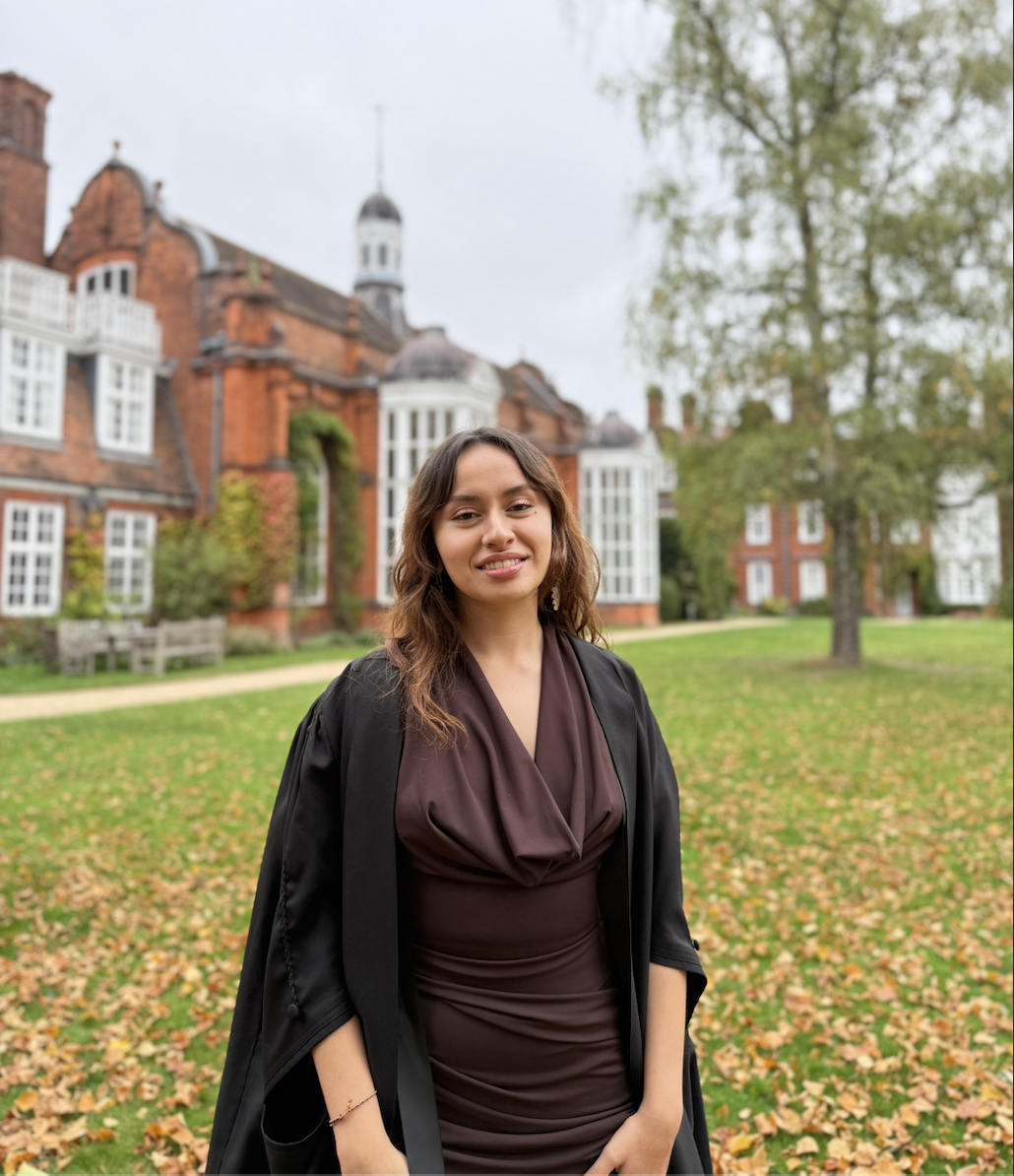
 Laura Isabel (Laurisa) Sastoque Pabón is an aspiring scholar, a creative writer and an advocate for digital cultural heritage. Her prose and poetry explore themes of mobility, loss and nostalgia, inspired by her own experiences of migration and dislocation as her life journey moves between Colombia, the United States and the United Kingdom. Her work has appeared in Somos en Escrito Literary Magazine and Routed Magazine, and she continues to work on long-form prose projects she hopes to share one day.
She is also a PhD student in Latin American studies at the University of Cambridge. As a researcher, she focuses on Latin American diasporic identity and drug trade history from a spatial humanities perspective. She currently works at the University of Southampton developing guidance and training for cultural heritage professionals to safeguard their digital assets. She was born and raised in Bogotá, Colombia and currently spends most of her time between Southampton, London and Cambridge.