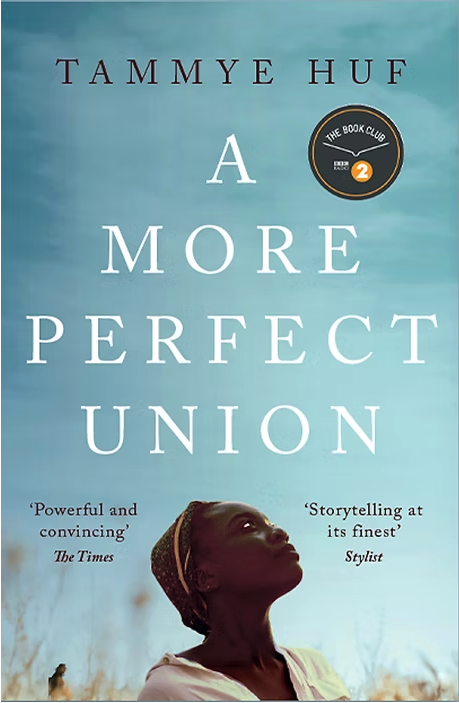
Author Jade E. Bradford delves into the historical fiction novel A More Perfect Union by Tammye Huf, published by Myriad Editions in 2021. Jade’s review is a Writing Our Legacy Creative Commission.
In writing A More Perfect Union, Tammye Huf has made the bold choice to join some of literature’s greatest authors, Toni Morrison, Octavia E. Butler, Colson Whitehead, to name but a few, in trying to share a fresh, sensitive, relevant, but historically faithful representation of the damages of the Transatlantic slave trade. However, there is a twist in Huf’s tale: it is based on the true story of her great-great-grandparents.
To understand the novel, we must reflect on what was happening in the world in 1848. In Ireland, the Great Famine decimated the population, with more than a million people dying. As a result, many people fled Ireland. People were living in unspeakable poverty, living in scarcely constructed homes that could be felled by a landlord wishing to repossess the land. At the same time, the British government still controlled trade in Ireland, meaning that the produce they had that was successful was exported out of Ireland, whilst people starved to death.
Across the Atlantic Ocean in the United States of America, extreme violence was the order of every day. Kidnapped, enslaved Africans and their descendants were forced to toil on plantations. Bought, sold and abused, they weathered unparalleled cruelty.
A More Perfect Union follows two years in the lives of Henry O’Toole, an Irishman fleeing famine; Sarah, an enslaved woman who has recently been separated from her mother and brother and sold in Virginia; and Maple, an enslaved woman who runs the house where Sarah has been sold. The novel explores survival and displacement and seeks hope in the connections formed among people despite their plight.
Each protagonist takes turns telling their story in their own words. You can barely turn a page without something horrific being plainly expressed. When surveying the books in her master’s study, Maple remarks, ‘I once knew a slave who could have read them. A reading slave. Master Jeremiah bought him that way and, when he found out, he blinded him.’ The author does not need to embellish the suffering to offer a gut punch.
After witnessing a female slave being whipped, Henry is traumatised. ‘I’ve known starving days and fever nights but I’ve never known this.’ It is in moments like this that we realise the extent of the suffering is almost inconceivable to the human mind. One might think a man who has seen his family die of sickness and starvation right next to him on the mud floor of their home or seen their dead bodies tossed over the side of a boat has felt every possible type of hurt and grief, but in seeing the cruelty enacted upon the people around him on the plantation, he realises the depths of degradation.
Indeed, the full range of human emotion is visible in this book. We are mistaken if we think of people living in survival mode as numbed to the mundanities of life, to pettiness, to jealousy, to sharing a laugh or to desiring a better future. Whilst it’s hard to read the book as ‘an epic tale of love and courage’ as the cover suggests, both of those things are present in abundance.
Seeing things through the main characters’ eyes, the distance we like to imagine between then and now begins to collapse. Henry, upon arriving in America, describes New York as a ‘great, dirty city, crowded and noisy’. The description feels almost jarringly modern, like something lifted from an online review. It serves as a reminder of how recent this history is.
We, the reader, realise it is foolish, in fact, not to think of our ancestors as just like us. In the same way that people skip past charity adverts of starving children on the television because they see themselves as removed from those people, it is easy enough for people to put a curtain down between their own human experience and that of people suffering. When we see Sarah up for sale and realise in no uncertain terms the fear she feels, we are forced to reckon with a simple fact. She is not a product. She is us. This fear is not safely contained in the past.
Knowing that Huf was inspired by the true story of her great-great-grandparents adds another layer of poignancy; imagining the harm your ancestors endured and trying to faithfully depict it on the page is an undertaking not for the faint of heart.
It’s no surprise that emotionally, this book is hard to read. Its central romance does offer a glimpse of hope, but the visceral detail of plantation life leaves a lingering, heavy feeling, discomfort, which is necessary if we are going to continue to learn lessons from humanity’s past unforgivable transgressions. Fiction shouldn’t simply exist to entertain the audience – its job is to hold a mirror up to our world and ask us to reflect on who we are, where we’re going. At a time when inequality and racial tensions feel once again like they are reaching a breaking point, there is something urgent in being reminded where these structures come from and what they do to people.
A More Perfect Union is published by Myriad Editions.
Buy a copy from the WOL online bookstore for £8.99 plus postage.
About the writer
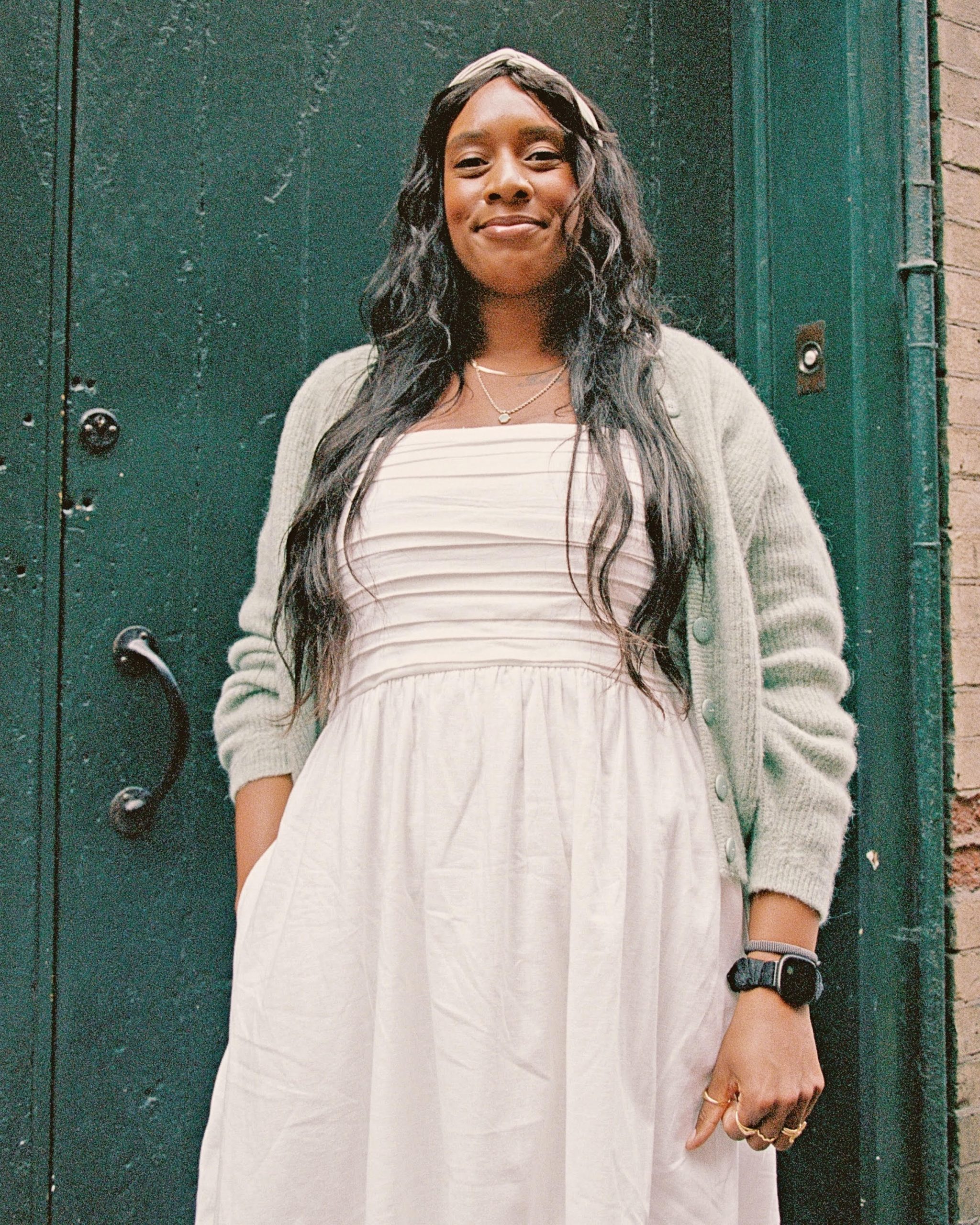 Jade E. Bradford is an author, communications and engagement professional and PhD researcher in Creative Writing at the University of Hertfordshire. Her short fiction has appeared in Wasafiri, Folding Rock, Breadfruit Magazine and Rowayat. Her short story, ‘Nine Night’, was longlisted for the 2025 4th Estate and Guardian 4thWrite Prize, while ‘Drifting’ won the 2024 Breadfruit Magazine Prize. Her Young Adult short story ‘An Embarrassment of Janets’ was highly commended in the 2023 Faber FAB Prize for Children’s Literature.
Her non-fiction work has featured in Photoworks’ Festival in a Box, Writers Mosaic, and across a range of digital platforms.
Jade is an alumnus of Literature Wales Representing Wales (2023/24), Black British Book Festival Writers on the Rise (2024), and Hay Festival’s Writers at Work (2025).