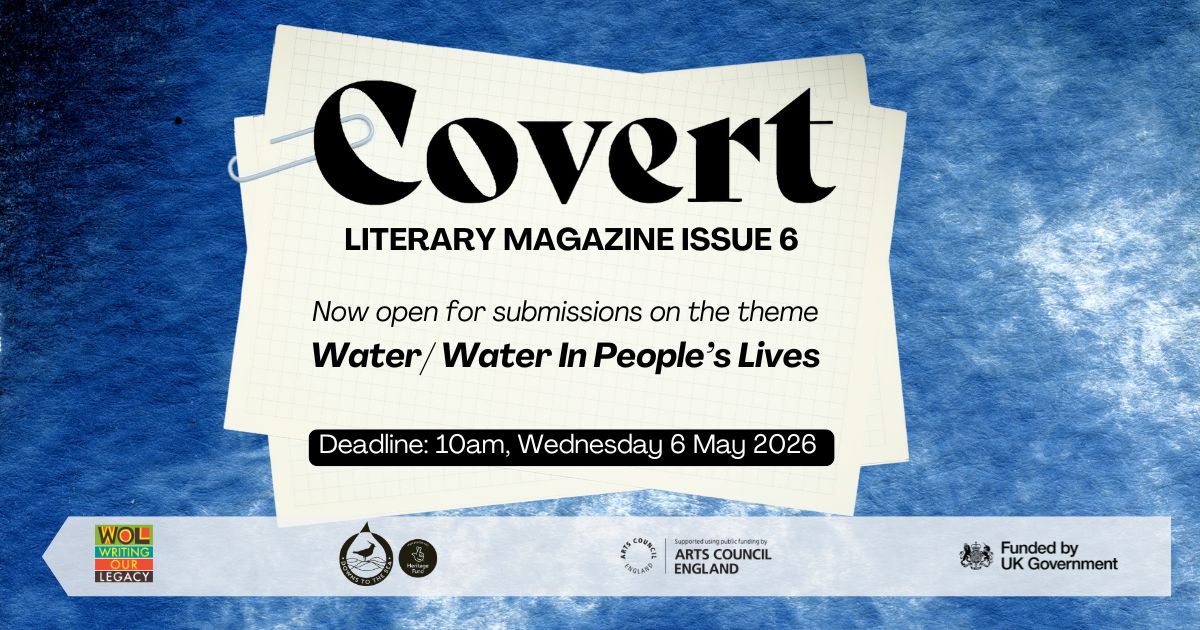
We are delighted to announce that the sixth issue of Writing Our Legacy’s Covert Literary Magazine is open to submissions on the theme of Water/Water in People’s Lives, and we are calling on you to respond with your poetic, literary and artistic gifts, imagination and expression.
The sixth issue of Covert is Guest Edited by Roy McFarlane FRSL, Fawzia Kane, Gemma Weekes, Remi Graves and Alinah Azadeh.
Submissions are invited in the form of original poetry, prose (fiction and non-fiction), theatrical scenes, audio/visual and artwork.
Covert Issue 6 is connected to our new programme, Downs to the Sea, a three-year nature programme that focuses on recovery and resilience in wetland habitats. It is led by the South Downs National Park Authority and supported by development funding from the National Lottery Heritage Fund.
The editorial team include: Amy Z. Glass, Claire Jacobs, Zita Holbourne FRSA and Jackie Mendoza.
Read on for inspiration on the theme, entry requirements and how to submit.
Covert Issue 6 Guest Editors tell us what water means to them and provide their invitations for your creative submissions:
Fawzia Kane: ‘My work here with the Port of London Authority takes me to the Thames’ edge, where I record the effect of water on different materials: metal, wood, and concrete. I’d like to encourage our writers to examine liminal parts of their bodies of water. How do the materials at the meeting of the wet edges affect each other? If the rushes, earthen banks, dried or decay against the new life of green or wildlife – even the sunlight – had voices: what would they say to each other? What are the songs or quarrels or laughter or reminiscences of rock and sand against the pounding sea?’
Gemma Weekes: ‘I would love contributors to think about water in both symbolic and concrete ways. Water lives inside us. In the form of blood, it’s the transport system of the body. It carries nutrients, stories, hormones, heat and warning signals. It travels constantly and without our input. Even our tears carry different chemical compositions depending on their purpose, whether they flow from grief or joy. Water keeps us alive, yet it can kill. It cleanses and erodes. It lubricates and dissolves. It softens and reshapes. It can drum gently on the roof or sweep an entire town away. Think of oceans and rainfall, but also of sweat, blood, condensation on glass, hair shrunken by humidity, and tears falling on paper. Think of floods and droughts, baptism and drowning, the hopeful boil of the kettle, the ponds we played beside as children, the bodies of water our families crossed, willingly or not.’
Remi Graves: ‘The sea is now a constant in my life, a reminder of fluidity and strength. I look out at the horizon and am invited to consider time, movement and our connection to all things.’
Roy McFarlane FRSL: ‘I’ve been the National Canal Laureate inspired by the histories, the communities and the personal stories flowing through our waterway. I’ve also been baptised, and I’ve caught the tail end of hurricanes. I’ve grown up on the stories of Noah and Jonah and the Whale. You will have your amazing stories. Remember, we live on an island surrounded by water, and we are a body of water; there’s water, water everywhere. I want you to be imaginative and inspired to write; the activism, the fantasies, the myths, the journeys, the personal experience, emotions and stories of water.’
Alinah Azadeh: ‘The sea in particular has been a major force in my life and work for the last twenty years now, through personal associations and experiences of loss, longing, recovery and renewal. It was a major inspiration and creative source of my work as writer in residence along the Seven Sisters and Sussex coast, UK – both as a solitary writer and in community. It is a key element in the book I am writing at the moment. I would like potential contributors to think about the journeys we make to and along the shorelines, riverbeds and lakesides we encounter – what prompts us to seek out an encounter with these bodies of water in our locality or in our imaginations? What are the emotional, embodied and political dimensions of this relationship? What is the nature of a dialogue with – and in – water that we can give form to in our storytelling, poetry, or image-making?’
Submissions guidance
This callout is only open for Black, Asian and ethnically diverse/BPOC writers and artists.
The submissions portal will be open until 10am, Wednesday 6 May 2026.
For this issue, we are accepting original fiction, non-fiction, poetry, drama, audio/visual and artwork.
You can submit up to two categories of your choice.
For all written entries, please upload as .doc or .docx files. In the interests of accessibility, where possible, please use size 14 font and 1.5 to double line spacing (single line spacing for poetry).
For visual art, we only consider high-resolution images. If you are submitting larger works with high megabytes, please consider sending via WeTransfer or Google Drive.
In each category, you can submit up to:
- Poetry (free verse, formal verse and anything in between): a maximum of 40 lines per poem and a maximum of five pages, submitted in the same document. Please be aware that our magazine is published in A5 size which may affect poetry with very long lines.
- Fiction: A maximum of two pieces per entrant. Maximum of 2,500 words. For Short stories maximum of 750 words.
- Non-fiction: A maximum of two pieces per entrant. Creative non-fiction – maximum of 2,500 words. Flash creative non-fiction, maximum of 750 words.
- Drama: A maximum of two pieces per entrant. Stage plays – maximum of two A4 pages. Screenplays – maximum of two A4 pages. Play extracts and monologues are welcome.
- Audio-visual: Maximum two minutes each piece. Maximum of two pieces.
- Visual art (photographic images, drawings, sketches, paintings, collages): Maximum of three works submitted in .png/.jpg/.jpeg format. For your artwork/photo to be considered for the cover art please submit in A4 format or aspect ratio 1:2.
Submit your work
Submissions must be received by 10am on Wednesday 6 May 2026.
Successful contributors will be offered a fee of £35 per person (we currently do not have the resources to pay for multiple successful submissions, only per artist selected).
Submissions portal – please submit your work here
Submissions guidance in PDF form
Submissions questions in doc form
Best of luck!
Find out more about Covert Literary Magazine
Funders
Covert Literary Magazine is part of our Arts Council England National Portfolio Organisation programme.
This issue is part of Downs to the Sea, a three-year nature programme that focuses on recovery and resilience in wetland habitats, led by the South Downs National Park Authority and supported by development funding from the National Lottery Heritage Fund.
The programme brings together a partnership comprising the South Downs National Park Trust, South Downs National Park Authority, Royal Society for the Protection of Birds, Western Sussex Rivers Trust, Brighton and Hove City Council and Writing Our Legacy.