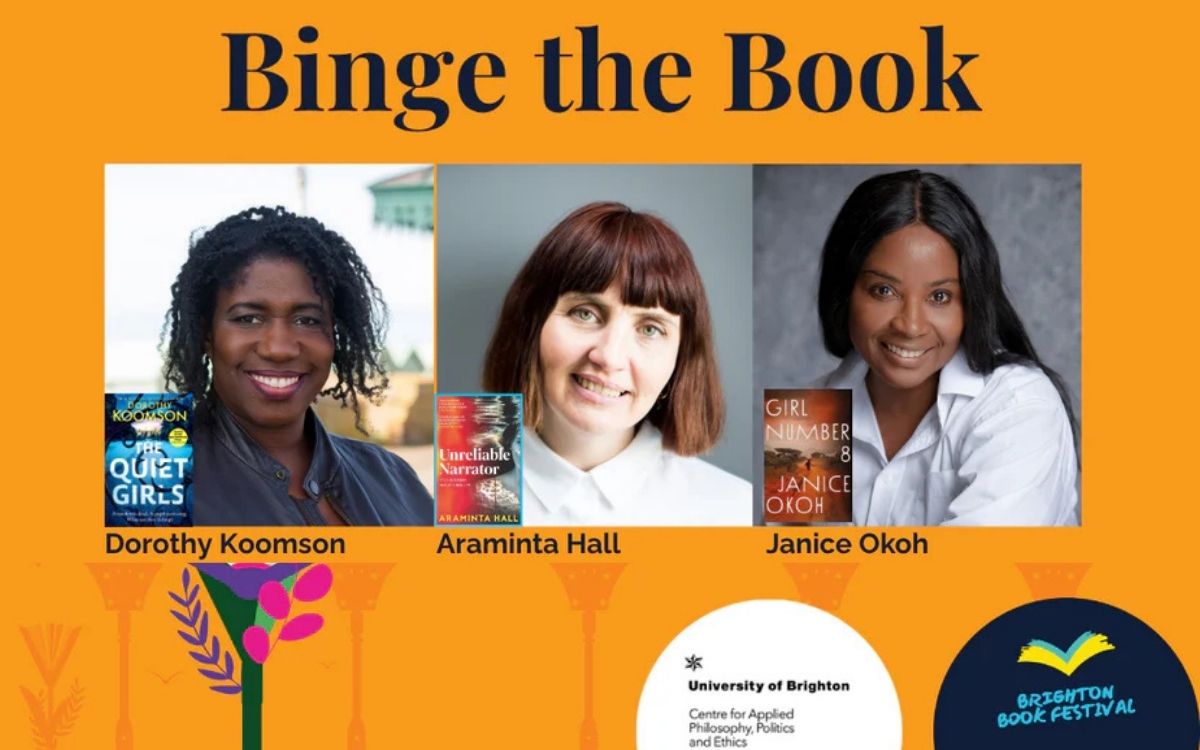
Writer and researcher Sonia Grant reports on Brighton Book Festival 2026’s event Binge the Book at Brighton University. This review is a Writing Our Legacy Creative Commission.
When I read the event’s teaser, ‘Come hear about the chaos, creativity, and controversy of turning beloved books into binge-worthy TV,’ I anticipated a lively and informative session. And I wasn’t disappointed.
The 270-seater Sallis Benney Theatre was approximately two-thirds full, with a palpable buzz – unsurprising, since panel Chair Dorothy Koomson and panel members Janice Okoh and Araminta Hall are all award-winning writers at the top of their game.
An irrepressible Carolynn Bain, owner of Afrori Books and one of the festival’s founders, opened the session with a clarion call for attendees to ‘get behind’ the authors – local writers, Dorothy and Araminta – and support writers’ work by buying their books and, of course, support the festival itself.
After introductions, Carolynn handed over to an affable Dorothy Koomson, who got down to the nitty-gritty: i.e., the reality versus the romanticisation of writers having their work adapted for either TV or film.
Dorothy began by asking what, I’m sure, was at the forefront of everyone’s mind: how did Araminta’s book, Imperfect Women, come to be adapted as an Apple TV Original? Half-jokingly, Araminta pondered if she should tell the official or unofficial version? In actuality, it turned out to be the unofficial version: a TV producer en route to a holiday picked up a copy of the book at the airport. This, of course, is the stuff of dreams.
Ordinarily, Araminta informed us, ‘an agent sends a pitch to a production company.’ And thus commenced a long process: ‘When television execs decided they wanted to option my book,’ Araminta recalled, ‘there were lengthy discussions.’ It turned out to be five years from the rights being sold to broadcast. And, at times, it had been an unnerving experience: changes were made to her original story, and she didn’t write any episodes of the six-part series. On the plus side, she was credited as an Executive Producer, alongside Kerry Washington, who also had a starring role. Although Araminta’s opinions were sought and she read all the scripts, she lamented, ‘Apple called a lot of the shots.’
Janice Okoh’s adaptation, Just Act Normal, began life as a play, Three Birds. ‘Many of the final scenes had not actually been in the play,’ she said. ‘For instance, there was no talking chicken!’ Having said that, she had been involved in the entire process and acknowledged that, ‘TV needed a lot of “story”.’
Dorothy asked how this impacted on her original piece. ‘In the play, the chicken was only ever mentioned in passing,’ Janice joked, ‘but in the show, it featured prominently as a “talking” character in its own right.’ As far as the production process itself was concerned, Janice advised that writers needed to be aware that, ‘there are other creatives involved in the process, as well as the people controlling the financial aspects of production.’
Panel Discussion Excerpts
Dorothy: What were the best or worst parts of the adaptation process?
Araminta: ‘It was like a dream – I didn’t believe it would make it to the screen! I felt as though I was valued when I was sent “dailies” i.e., reels on a regular basis. It’s at this point you realise that there are many things planned that were not in the book!’
Janice: ‘The actual writing of episodes was OK, but I didn’t like the fact that I had no real control, and I hated feeling as though I had to constantly fight my corner.’
Araminta: ‘I struggled with some of the changes – they Hollywood-ised it! I did, however, like that they kept to my overall themes. Consequently, I forgave their distorted depictions of my characters and that they hadn’t used the actual lines from the book. That aside, I loved the finished product.’
Dorothy: How easy was it to write for the screen? Is it easier to describe it from a screenwriter’s perspective or the other way around?
Araminta: ‘With books there can be a tendency to overwrite. You set the scene… but so much of it is about cutting things out.’
Janice: ‘Between screenwriting and writing a book, there’s much more “story” expected.’
Dorothy opened up the floor for a quick-fire question and answer session.
Dorothy: How do you approach writing?
Araminta: ‘It begins with a “germ” of an idea; usually something with a social or political bent to it. The plot actually comes quite late in the creative process, but things can be moved around accordingly. Initially though, the focus is on developing characters.’
Janice: ‘Invariably, aspects of my writing include perspectives of my personal experiences.’
Dorothy: What are the realities, or misconceptions, of adaptations for TV or film?
Araminta: ‘As far as being on set to watch filming is concerned, it’s actually quite an “unglamourous” experience.’
Janice: ‘I had to write/re-write several drafts. I remember the long hours. Realistically though, there is a slim chance of writers getting their work adapted.’
Araminta: ‘Don’t think that TV shows will sell more of your books!’
Dorothy: Does TV influence your writing style?
Araminta: ‘Writing a pitch for TV is a brilliant way to get a first draft for a novel.’
Janice: ‘TV makes it an easier process, especially if you have no idea about structure.’
Dorothy: ‘I agree, TV definitely facilitates structure and plots.’
Dorothy concluded by drawing attention to the ‘elephant in the room’: AI, which drew a good-natured collective *sigh* from the audience. ‘AI has no place in writing,’ Dorothy stated categorically. She has had thirty-four editions of her work ‘stolen’; to date, worldwide, approximately three million books have been ‘pirated’.
‘AI makes writers lazy, and has no place in their toolboxes,’ she advised. And on a cautionary note, she advised, ‘Instead of using AI, get yourself some writing friends.’
The hour-long event seemed to whiz by, which was testament to the fact that it had been thoroughly enjoyable, educational and entertaining.
About the writer
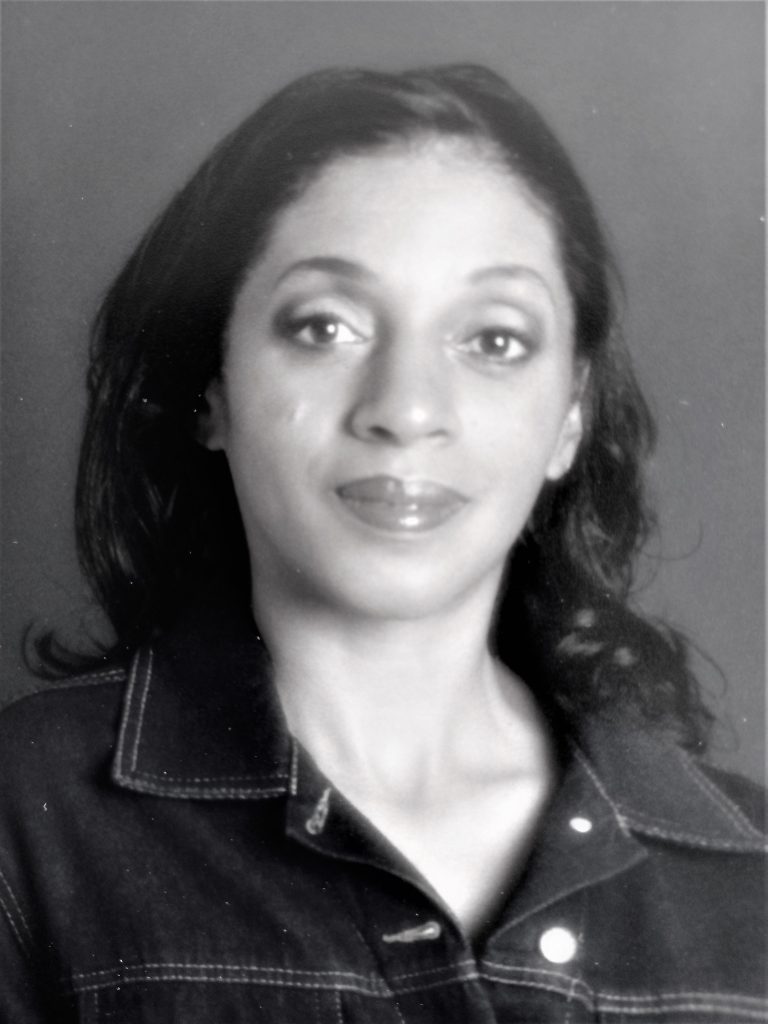 Sonia Grant is a writer currently working on a non-fiction trilogy: Black Britannia: 1910s – 1930s.