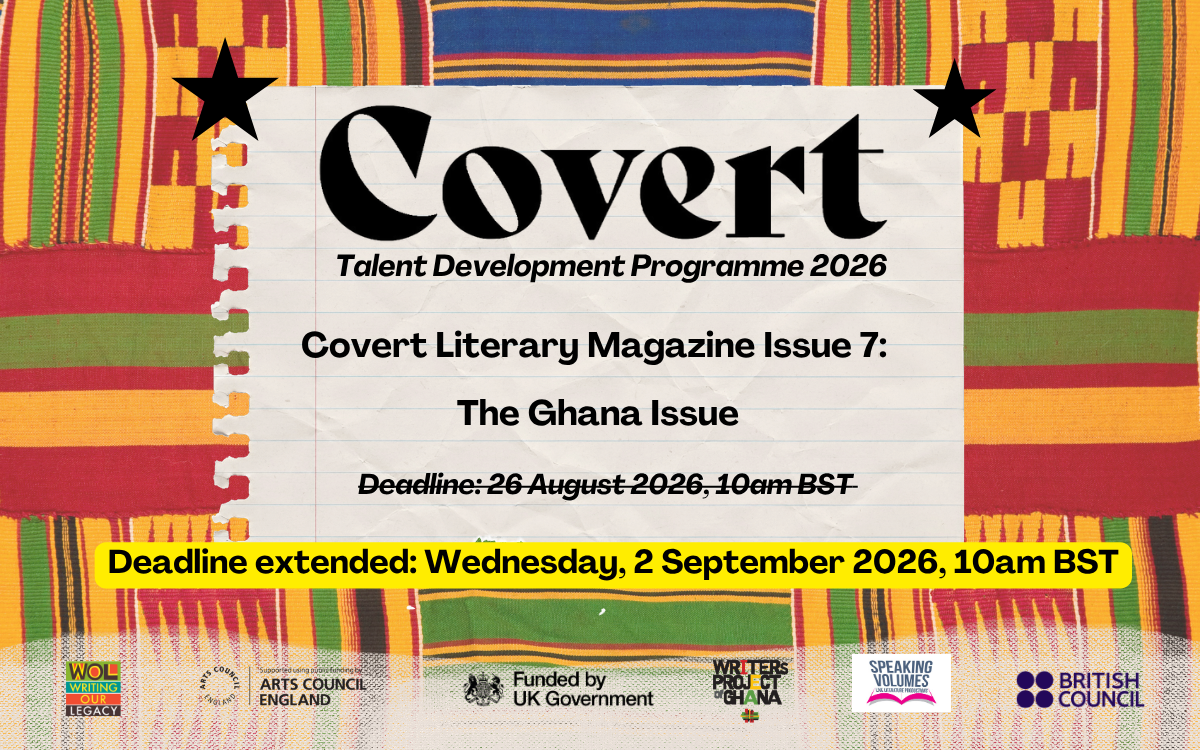
We have extended the deadline for our Covert Talent Development Programme 2026: The Ghana Issue until Wednesday, 2 September 2026, 10 am BST.
This year’s special Covert Literary Magazine Issue 7, themed ‘Ghana’, is produced in partnership with Writers Project of Ghana and aims to showcase and nurture the talent of people living in Ghana or of Ghanaian descent living in the UK.
The Covert Talent Development Programme is a great opportunity for Black, Asian and ethnically diverse/BPOC writers living in Ghana or who are of Ghanaian descent living in the UK, to develop their writing practice with a range of professional writers, who will provide an online programme of creative writing workshops, editorial feedback and mentoring support, as well as peer-led writers’ groups, from September to December 2026.
The selected cohort will be made up of 16 participants: 8 writers of Ghanaian descent in the UK and 8 writers in Ghana.
For this issue, we welcome Guest Editors: Martin Egblewogbe (Ghana), Mamle Kabu (Ghana), Derek Owusu (UK) and Zoe Adjonyoh (UK). Plus the Editorial Team: Elizabeth Johnson (Ghana), Mamle Kabu (Ghana), Anni Domingo (UK), Akila Richards (UK), Amy Glass (UK).
This issue is funded by Beyond Literature Borders from the British Council and Speaking Volumes, and Writing Our Legacy’s Arts Council England’s National Portfolio Organisation funding.
Applications for the Talent Development Programme will open on Thursday 30 July 2026.
The deadline to apply is Wednesday 26 August 2026 at 10am BST. Deadline extended: Wednesday, 2 September 2026, 10 am BST.
Please read the Covert Talent Development project page for more info and our Guidance on Applying.
What the Programme Will Include
The programme will include:
- Four online writing workshops
- Four online creative writers’ group
- One online mentoring session with one of the Guest Editors
- Publication in Covert 7 magazine
Find out more about the programme, our theme and the Guest Editors.
About the Theme: Ghana
The theme for Covert Literary Magazine Issue 7 is ‘Ghana’.
Guest Editors tell us what the theme means to them and provide their invitations for your creative submissions:
Mamle Kabu: ‘Almost six decades after becoming the first sub-Saharan country to shake off colonial rule, has this multi-ethnic conglomerate named Ghana attained true nationhood? Has it emancipated itself from mental slavery as Garvey urged and Marley sang? And is it aware of the rate at which it is haemorrhaging culture? Culture is by nature subject to evolution, but some losses are more sobering than others, like the sharp decline in the use of Ghanaian languages between my generation and my children’s. When I was in primary school in Accra, it was virtually impossible to find a Ghanaian child who did not speak a Ghanaian language, but this had changed significantly by the time my children got to primary school. We are talking about an exponential haemorrhage, not just in the primary vehicle of language but across the cultural board.
The arts have always been an important medium of cultural preservation, and it has been exciting in recent years to see how literature can simultaneously transform and preserve Ghanaian culture. I will be excited to see writing that speaks to these questions of national and cultural identity.’
Martin Egblewogbe: ‘Writing that examines or links our Ghanaian histories with the present, and the present with the future, at the individual, social, political and national levels will be of interest to me. Infusions of folklore and highlights of how myth is present in our daily lives would offer interesting new ways of seeing our current techno and materialistic – even hedonistic present.’
Zoe Adjonyoh: ‘Kwame Nkrumah’s influence established Ghana as the spiritual and political seat of Pan-Africanism. But how, both within its borders and across the global diaspora, are we continuing his vision of uniting people of African descent, fostering pride in African history and culture, and advancing political and economic liberation?
To me, Ghana is both home and a contradiction. It is a place of belonging, yet its increasingly authoritarian, evangelical Christian approach to anti-LGBTQI+ legislation has made it, at times, feel like a place of exclusion. My career in food has been rooted in a deep pride for Ghana’s extraordinary hospitality and a desire to rediscover and share my heritage. Through food, I have sought to bring the diaspora together, allowing Ghana’s cuisine, culture and politics to shape my work.
For this issue, we ask: What has Ghana made you proud of? What has it failed to live up to? Where is there cause for celebration, and where is there reason for condemnation? More than six decades after independence, how is Ghana delivering on the promise of Pan-Africanism today?’
How To Apply
It’s free to apply. Access our Google Forms portal to apply when you’re ready.
The deadline for applications is Wednesday 26 August 2026 at 10 am BST. Deadline extended: Wednesday, 2 September 2026, 10 am BST.
You will be asked to input information and attach some documents, including our proposal and writing sample. Read through our Guidance on Applying beforehand to review the questions and help you prepare before you start.
Funders
This issue is funded by Beyond Literature Borders from the British Council and Speaking Volumes and Writing Our Legacy’s Arts Council England’s National Portfolio Organisation funding. This project is delivered in partnership with Writers Project of Ghana.
About Covert Literary Magazine
Covert Literary Magazine is a publication by Writing Our Legacy showcasing global majority/BPOC creatives based in or with a connection to the South East England, established in 2020. We publish fiction, poetry, creative nonfiction, hybrid forms and artwork, with future issues embracing more experimental, journalism and audiovisual content. Our aim is to provide a platform for new and underrepresented diverse talent for whom mainstream publishing opportunities are inaccessible, whose work is reviewed, edited and published alongside more established names .
With each issue, we welcome Guest Editors and an Editorial Board of writers, editors, creatives and artists from across England, the UK and beyond. Previous Guest Editors include Umi Sinha, Dean Atta, Mohammed Z. Rahman, AFLO. the poet, Jessica J. Lee, Sean Wai Keung, Titilayo Farukuoye, Elaine Chiew and many more.
The Editorial Board is led by CEO/Founder Amy Glass with invited guests. Our previous Editorial Board has included Sharon Duggal, Katy Massey, Jasmine Isa Qureshi, Akila M. Richards, Zita Holbourne FRSA and Tammye Huf.
Contributors are invited to respond to a theme set for the issue. All contributions are selected on a blind basis by our editorial team and editors. Each contributor receives a fee, a copy of the magazine and an invitation to read at our launch events and year-round programme.
With each issue we run a Covert Talent Development Programme, working with a cohort of global majority creatives and industry mentors to develop pieces for publication as well as coaching and general professional development.
In October 2024, we launched a new print, digital and institutional subscription service for our readers, allowing people to subscribe on a quarterly or yearly basis. For more information about Covert, see our webpage for the magazine.
About Writers Project of Ghana
Writers Project of Ghana (WPG) is a literary arts organisation focused on increasing the visibility of Ghanaian writers and creating networking opportunities between them and their counterparts across the globe. Through dedicated programming such as workshops, readings, and publications, and by organising the annual Pa Gya! organizing the annual Pa Gya! A Literary Festival in Accra, Writers Project of Ghana remains committed to working with partners to deliver on our objective. WPG is excited by this partnership with WOL and looks forward to the process leading to the publication and launch of the special edition of Covert Literary Magazine.
About Speaking Volumes
Speaking Volumes was founded in the UK in 2010. As a small, independent organisation with no core funding, but which has created its own opportunities to work across the UK and abroad, they have in-depth experience and an understanding of the challenges involved in both international working and uplifting unheard voices in the literature sector.
Speaking Volumes has developed a reputation for supporting underrepresented writers from around the world through events, publications and professional resources, and by creating international platforms for them to share their work. Over the last decade they have conceived various ongoing projects run in collaboration with partners across Europe and the USA eg their long-term Breaking Ground series. This has made them cognisant of the many benefits of such projects including, among others: establishing a solid network of international contacts; developing mutual trust and exchanging expertise; growing opportunities for underrepresented artists from both the UK and abroad; and inspiring new project ideas.
About the British Council
The British Council is the UK’s international organisation for cultural relations and educational opportunities. We support peace and prosperity by building connections, understanding and trust between people in the UK and countries worldwide. We do this through our work in arts and culture, education and the English language. We work with people in over 200 countries and territories and are on the ground in more than 100 countries. In 2024-25 we reached 600 million people.
The Literature team in the UK work together with colleagues in British Council offices in over 100 countries around the world on programmes that help to build those important connections and increase mutual knowledge and understanding. The connections they build through arts and culture transform lives and create positive change.
The British Council is working with independent literature organisation Speaking Volumes to roll out the Beyond Literature Borders Grant Programme. This scheme is a pilot which aims to enable the British Council to support a wider diversity of literature projects and organisations.