 Farah Edwards Khan piece Martyrs on Parade was originally published in Hidden Sussex, a new anthology for Sussex: Fiction, non-fiction and poetry from the Black, Asian and Minority Ethnic experience (Writing Our Legacy, 2019). Farah’s story recounts a first-time visit to Lewes Bonfire night and recollections of home, in India, of the equally vivid memories of the Moharram procession.
Farah Edwards Khan, born in Mumbai in 1974, grew up in the central Indian city of Bhopal. Descended from a line of progressive Muslim women rulers, whose legacies imparted a unique perspective on life in India, Farah’s love of writing developed from a childhood filled with Urdu poetry, the shared stories of a large extended family and the classic literature passed on by her German-Irish teacher. Farah has worked with numerous journalists, as well as writers such as Dominic Lapierre and Indra Sinha, on oral histories and novels illuminating the catastrophic 1984 Bhopal Gas Tragedy, which she witnessed as a child. Farah has a teaching B.A. B.Ed, and recently studied on the creative writing programme in Brighton, where she has lived for nearly two decades.
Farah’s own stories focus on the lives of ordinary people in India. She is currently writing a book of her life in Bhopal.
Martyrs on Parade
by Farah Edwards Khan
I didn’t want to leave Brighton and go back to India, I just wanted to spend more time with Tim. The six-month visa was coming to an end, and plane tickets were booked to fly back to Bombay. My heart ached, and I couldn’t eat or sleep.
Yellow leaves slowly began to fall from weeping trees. Starlings massed over the old West Pier, which had not yet been destroyed by fire. Some days had crisp air and golden sunshine, others were damp and heavy, grey-hued like the skin of a dying man.
Tim mentioned that Lewes Bonfire night would soon be bringing about a great public gathering. As a child in Bhopal I had heard the poem’s words: ‘Remember, remember, the fifth of November, the gunpowder treason and plot…’
Instead of the date, I remembered my mother, exaggerated red lips and eyes stretched-wide in recitation, between chews of paan. I don’t think she ever did explain the significance of the events the poem named but failed to describe.
Bonfire night. The public processions I’d joined in India took place in daylight, I had never walked at sundown. What kind of remembrance needed the cover of darkness to express itself?
The narrow streets of Lewes are filled with thick smoke, an orange hue has blanketed the town centre, intoxicated men and women sway on the pavement, laughing and shouting. People dressed in black and white stripes holding up burning crosses and heads on stakes stride jauntily along the road. Life-sized papier-mâché effigies of Guy Fawkes tied up, his head bent low on a cart, bump past, dragged by men dressed in Jacobean costumes and high hats. Many clutch flaming torches that swoosh above the crowd of heads.
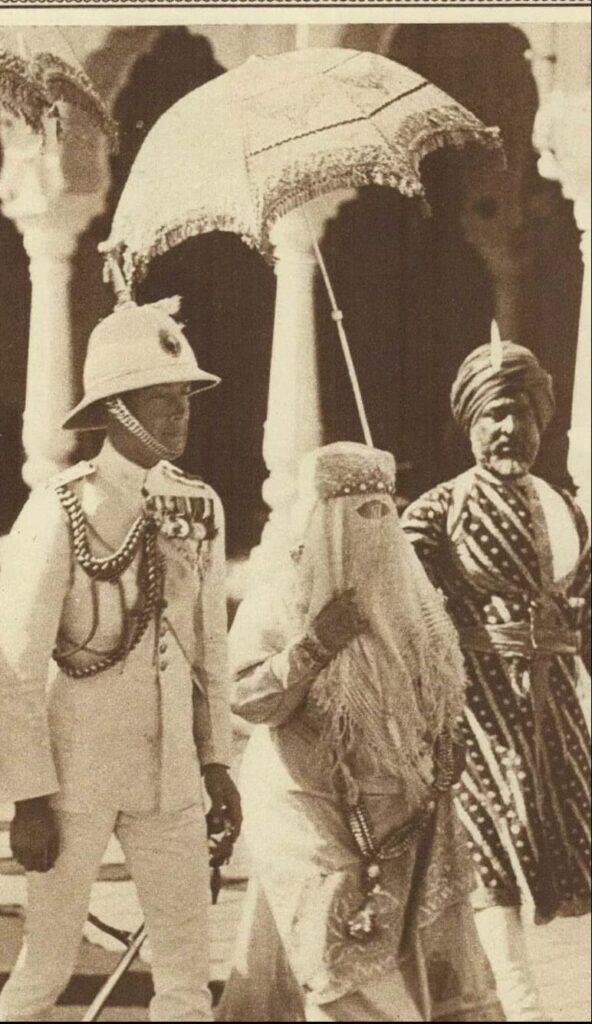
My thoughts drift back to when I was about six and my nanny Hasina walked me for what seemed like miles to see the Moharram procession in the old city. ‘Chalo, Baby, you must come with me to see all this and learn what it is to love God.’ Moharram, I was to learn, was not for the faint-hearted. I watched, dumbstruck, hundreds of distant-eyed men rhythmically slashing at themselves while incanting, mournfully, ‘Ya Hussain… Ya Hussain’ – drawing welts and bright blood, wielding swords and whips dripping with fresh gore, a thrashing, pounding mass martyrdom trailed by grieving wives, sisters, and mothers. This macabre procession shuffled along bearing tall papier-mâché replicas of mosques and Shia monuments elaborately decorated with gold and silver and carried by men dressed in black. They took turns to lift these heavy burdens to shoulder height in order that those seeking longevity and happiness could pass under them.
In the present, a shatter of magenta fireworks lights up the northern sky. Sulphur fills the nostrils as black metal drums pass by, pulsating, backed by the roar of fires housed in carts that rumble across cobbled stones, throwing sudden fierce heat at the press of onlookers and their awed faces: small children on parent’s shoulders, mouths agape at the orgy of noise and incandescence. The wailing of bagpipes grips the heart like a sea siren.
The secret of the seven societies is now out. ‘A rope, a rope, to hang the Pope, a penn’orth of cheese to choke him, a pint of beer to wash it down, and a jolly good fire to burn him.’ Young and old together tread the parade, which snakes its way through twisting, claustrophobic lanes, a serpentine creature full of jovial pride in the history of England, playfully denouncing the deaths of the 17, whom some faraway Queen commanded be burned at the stake for their beliefs.
In my childhood Bhopal, Moharram’s pride blazed with a different intensity.
Above black mourning trousers, shirtless torsos glistened with fresh crimson. Collections of steel swords and spears were borne by these bloodied men in a trance. Some held short chains tipped with metal blades that, as they were rhythmically jerked back over or around shoulders, spread like talons to hack across raw open skin. A burst of shouting urged onlookers to get back out of the way; another half-naked man suddenly emerged, scampering and bucking along past the crowd like a mad horse tied with ropes, as though he were possessed or under a spell. As more warnings were boomed out to ‘keep away’, the man chanted sounds of a language, which no one could understand. Throughout this spectacle the parade’s lamentation, its insistent cadence, drove the flailing remorselessly on.
I had never seen such insanity before. Green and red was everywhere, poison and blood, depicting how the grandsons of the prophet were slain for water. Nobody in the procession smiled; there was no laughter, only grief, as fierce as if the marchers had just heard the awful tidings of 680 AD.
But there were also food stalls with steaming kichara (spicy meat porridge), pakoras, hard boiled eggs served with salt, tandoori chicken on hot skewers and, yes, ‘old ladies hair’ – or candy floss – which I loved so much.
In Lewes, by the hot dog sellers and the toffee apples, hawkers sell Native American feathers, head dresses with large horns, and swords, moulded in China, that run red only with the timed flashing of led lights. The atmosphere is festive, elated. Perhaps for a child not, after all, so different to the martyrs’ remembrance from which Hasina always bought me back home, safe, with a smile on my face and balloon in my hand, stuffed with candy floss and blessed by the bloody spirit of Moharram. But I am not, this time, going happily home. Will this fire, smoke, commotion be my last memory of England?
Hidden Sussex, a new anthology for Sussex: Fiction, non-fiction and poetry from the Black, Asian and Minority Ethnic experience (Writing Our Legacy, 2019). The book is available worldwide as paperback £11.39 and ebook £6.99 from https://smarturl.it/HiddenSussex.
Twenty-three contributors from across East Sussex, West Sussex and Brighton tell their own stories and narratives.
The anthology tells stories of many firsts – first trip to Afro-Caribbean hairdressers, first sexual awakenings, first visit to the Chattri Memorial. The writing also deals with middles and ends – raising children, solitary pursuits, and the deaths of friends and family. We are transported to local places of interest such as Cuckmere Haven and Brighton Pavilion, and also elsewhere – to Pakistan, India, Iran. Some authors deal with pressing issues of contemporary Britain, including Brexit and the Windrush scandal, while others cast their eye over history and the natural environment.
Contributors are: Georgina Aboud, Jenny Arach, Sheila Auguste, Alinah Azadeh, Priti Barua, Bebb Burchell, Josef Cabey, Suchi Chatterjee, Lisa Climie, Joyoti Grech Cato, Sally-Claire Fadelle, Josephine Hall, Jasmine Harris, Maggie Harris, L Oluwafemi Hughes Jonas, Farah Edwards Khan, Dulani Kulasinghe, Georgina Parke, Annie Richardson, Zaid S Sethi, Hayat Nezameddin Shehab, Sonny Singh and Nina Thaddeus.
A Writing Our Legacy publication. Editors: Umi Sinha, Dean Atta and Colin Grant