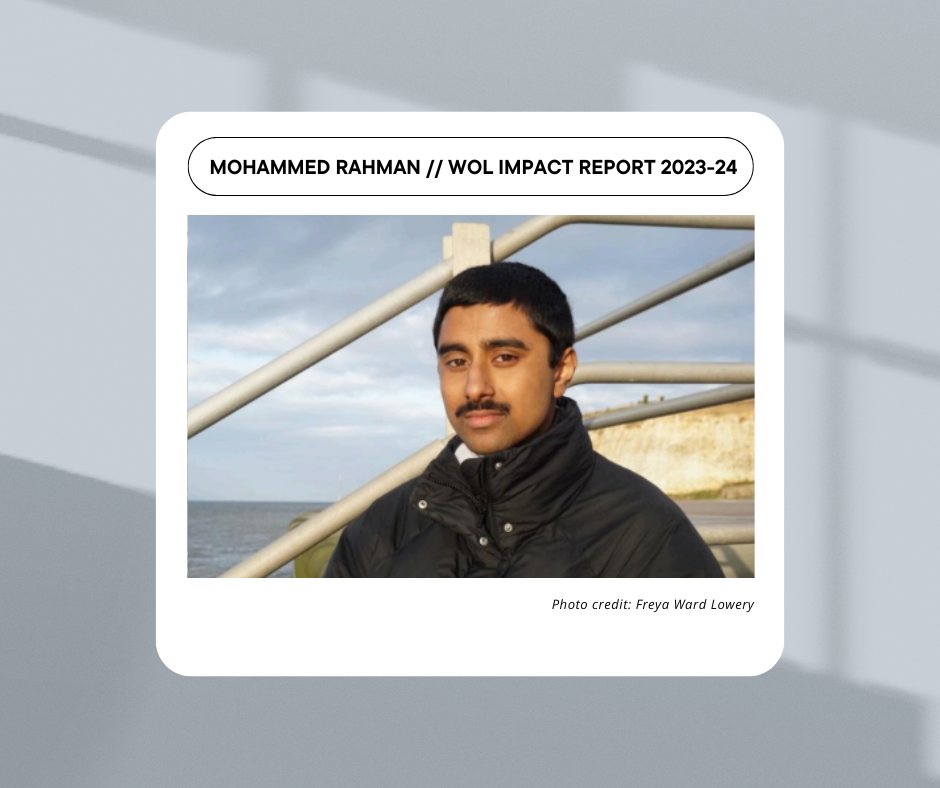
Mohammed Rahman was among four writers interviewed regarding the impact that Writing Our Legacy has had on his writing. This case study is part of the independent evaluation report conducted by Plenty Productions, spanning over 10 years of our work at Writing Our Legacy. Keep reading to learn more!
Impact Report //
Mohammed (Mo) has a background in social anthropology and writes creative nonfiction, short stories and zines, and also has a visual art practice as well as writing.
Mo has had work published in issue 2 of Covert (illustration) and also had a short story published in issue 3. His work focuses on migrant experience in particular intergenerational relations. Mo has had work published before in various other outlets but sees WOL as offering unique benefits for writers of colour. One of the main benefits of WOL Mo feels, is providing BPOC writers with a real sense of community, a strong level of support and lots of empathy:
“What stands out for me with WOL is the real sense of community for BPOC writers. The level of support is remarkable as is the generosity with which writers from different levels of experience support each other. There’s a lot of empathy about what it means to be a writer of colour in the UK context within the community of WOL creatives as well as some of the challenges and shared experiences of that. WOL is really good at connecting people at different stages of their career and we find more established writers are very generous of their time because of the community our organisation fosters.”
WOL has also given Mo access to local Sussex knowledge as well as national networks which is really valuable he feels: “Exposure to international acts via the poetry room and also via Covert magazine has also been invaluable for me and has served to broaden my writing horizons.” Other writing organisations have a more general audience and Mo has not come across another writing organisation like WOL before. Mo feels that organisations such as WOL are really needed: “Many BPOC writers are second generation of migrant parents; we may also have English as a second language and may have come to writing via a less established routes; as such we can lack access to industrial contacts that more established white English middle class peers are more likely to have in the largely white establishment of writing in this country. As such you can feel like an outsider and there can be a sense of alienation as a result.” The most ‘stand out’ contribution that WOL has given Mo he feels, is that WOL has inspired a real sense of possibility as a writer:
“WOL has taught me that it is possible to have a career in writing. Meeting people who are doing just that has been truly inspiring for me.”
About Mohammed Rahman //
Mohammed Rahman (he/they) is a British-Bengali visual artist and writer based in London. His work puts socio-political and personal histories in conversation through the lens of the domestic. Mohammed’s visual output includes illustration, painting and zines. His literary output includes short stories, poetry and essays.
With a background in social anthropology (BA, SOAS), Mohammed approaches art as an intimate and political force probing and mutating the ordinary. Drawing on dreamscapes, globality, queerness, biography and socio-historical perspectives, he creates work that celebrates his communities’ internationalist dreams, disrupts violent power structures and makes peace with unspeakable chaos.
Find out more about his work here
Covert Literary Magazine: Edition 2, Spring 2022: PRINT VERSION | DIGITAL VERSION
Covert Literary Magazine: Edition 3, Summer 2023: PRINT VERSION | DIGITAL VERSION