Plenty Productions was commissioned to conduct an independent impact evaluation spanning over 10 years of our work. As part of this evaluation, two organizations collaborating with WOL were interviewed to assess the impact that WOL has had on their operations. These case studies, including one featuring Anooshka Rawden from the South Downs National Park Authority, were incorporated into the report.
Anooshka Rawden is the cultural heritage lead for the South Downs National Park Authority. She first came across Writing Our Legacy (WOL) via reading a copy of Hidden Sussex:
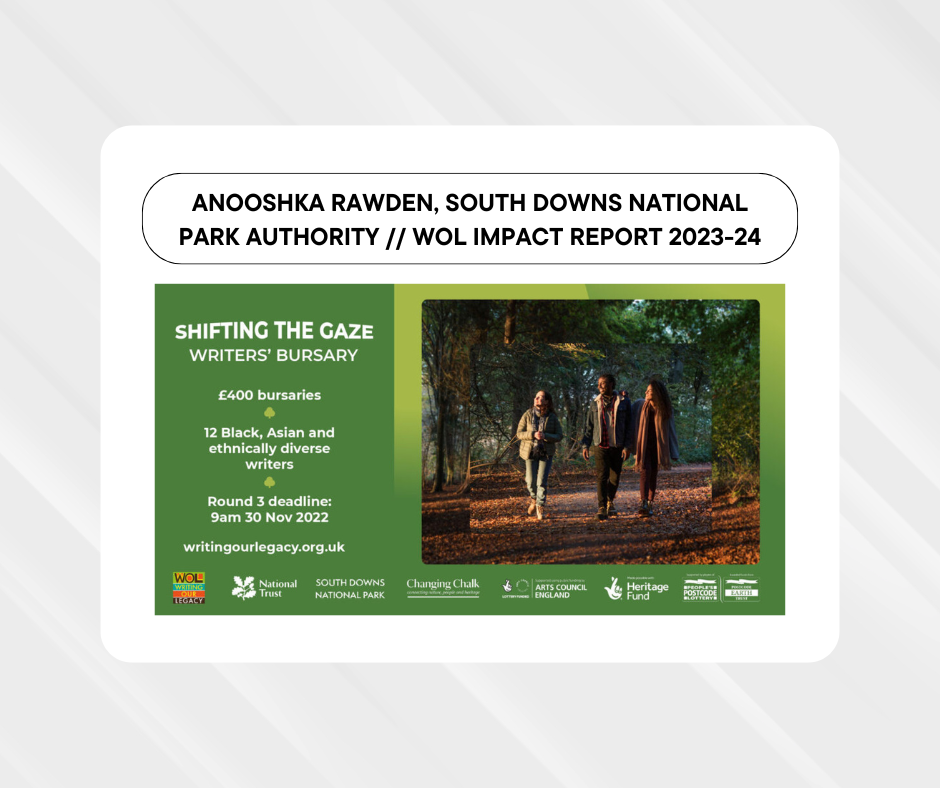
“I immediately realised that here was a body of work drawn from chalk footpaths, downland wildlife and the remnants left of historic settlement which was far richer than we as a National Park Authority had been doing. I wanted to connect to an organisation who is working in the same space as us (the landscape) but doing such impactful work, where people create narratives of the land in ways that we hadn’t been able to achieve, so there was a real interest in finding out about WOL and how to support their work. Since then we have worked with them in a number of ways. We supported seed funding for micro bursaries for Shifting the Gaze (2020-2021) and that was the start really. Those 15 bursaries were really successful and seemed to make a big difference to the recipients and we received lovely feedback from that, some really powerful stuff. For relatively modest investment there was strong impact from the bursaries I would say. We also made a sponsorship contribution to Covert (in 2022-2023).”
Anooshka feels that the relationship has been transformational a number of reasons:
“Working with WOL has also helped me in my own professional practice (and also others within our team) to think about our status and the power dynamics in partnerships and how we can be more reflective practitioners and a more reflective organisation as a whole. That’s a big testament to the influence and impact of working with such an open and inclusive organisation as WOL. My experience of working with Writing our Legacy has been that they are the more experienced and knowledgeable partner. Much of that rests with Amy herself. So whilst on paper WOL might be the smaller organisation, in terms of our partnership they are definitely the leadership organisation and are the more experienced partner in terms of their knowledge, skills and strategic awareness, which they bring to our work together.”
The nurturing approach of WOL is also valued by Anooshka:
“There is a community support approach in what WOL does in its work with creatives and it’s all about nurturing and growing. You always know when you are working with WOL that people will be cared for and supported and treated fairly. They’ve worked hard in developing from a network into a structured organisation to invest in getting policies and procedures in place that communicate its values. I find this approach is also reflected in our partnership dynamic since I find Amy incredibly supportive and a wise peer, who I continually learn from. We also get reassurance from the authenticity of work with WOL, as WOL is the community and it’s not an organisation that does work ‘to’ a community. WOL is wholly representative of the global majority voice that it serves so well, and working with WOL provides us with an opportunity not only to work authentically but the quality and success of the engagement is that much higher due to that authenticity.”
“It would be true to say that our partnership with WOL has moved us an organisation much further down a road to understanding what equitable practice looks like and how to implement it. We still have a long way to go, but WOL has really helped us make a step change as an organisation with key organisational learning which we wouldn’t have achieved otherwise. WOL has also diversified the partners that we work with and our partnership has demonstrated a commitment to addressing the disparities in access to the countryside which is very powerful, timely (actually, long overdue) and important. Having a partnership like this means that we have been able to deliver a public commitment to trying to shift very established problematic relationships that countryside has with some communities around access to the landscape. It’s been a hugely positive relationship with WOL and we have a really strong partnership now which puts us both in a good position for future collaboration.”