

One of our writers from the Writing Our Legacy @ Changing Chalk Associate Artists Programme, Nina Thaddeus, writes about her experience on the Orchid and Butterfly walk with the National Trust Rangers.
On a sunny June day in 2022, I attended an Orchid and Butterfly walk organised by the National Trust as part of the Lottery funded Changing Chalk project. As one of the project’s delivery partners, I felt privileged to be representing Writing Our Legacy, a Community Interest Company that enables Black, Asian, and ethnically diverse people to tell their story through writing and creative arts. The other participants were from national nature organisations also associated with the project.
We met at Saddlescombe Farm. Nestled in the South Downs, this working farm is also a base for National Trust Rangers. After brief introductions, we were taken by jeep to an area known for its diversity of plants and insects to begin our walk.
As one of the older participants, I followed behind the main group through fields with furrowed mud trails that were extremely uneven. Josie, the Volunteering and Community Manager escorting me, aware that this walk could challenge my ability, informed me of plans for the National Trust to invest in a fleet of off-road mobility scooters. On hearing this, I thought of the many who would benefit from this initiative.
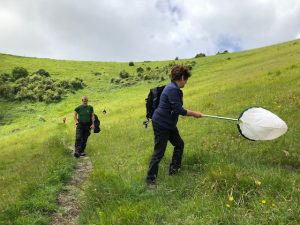
Catching butterflies with the National Trust Rangers
The event began with a talk introducing the group to the butterflies and moths found in chalk grasslands. This was followed by a gentle walk up the grassy wildflower-covered hill, where we were handed huge butterfly nets. Finding myself free to run around the Downs trying to catch butterflies was exhilarating, and evoked friendly competitiveness in all who participated. An Adonis Blue butterfly, which has a fascinating symbiotic relationship to the ants that live in the chalk hills, was the first to be caught. This was followed by a delicate Small Blue which only survives in areas where Kidney Vetch, its sole food, is found. We quickly scrutinised these and other interesting specimens in viewing jars before they were set free unharmed.
After a refreshment break, we walked towards a wooded area. Unexpectedly, a grassy slope that is home to tens of thousands of Common Fragrant Orchids came into view. The green hill, speckled with pale pink and purple flowers, was an absolute joy. Excitedly, I approached these common, yet beautiful plants that smell of their pollinating moth. This was just the appetiser.
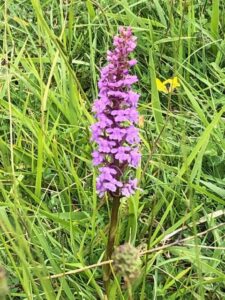
Spotting orchids in the wild
We entered a wooded area in the knowledge that the bank below can host over twelve varieties of British orchid. This bank had for years been left to become dense scrub but, twenty years ago, a ranger met someone who said that the bank, in his childhood, had been full of orchids. The National Trust cleared the area and within a few years the orchids began to return. The next hour was filled with an exhilarating exploration of the many orchid varieties thriving beside an abundance of wildflowers, shrubs, and thick grasses.
Amongst the orchids spotted that day were Butterfly Orchids. This delicate plant has a tall single flowing spike with whitish green flowers and petals that spread out like butterfly wings to attract night-flying moths. Then, Early Purple Orchids, a common pinkish purple flower with distinctive dark spots on its dark green basal leaves. The Rangers talked about orchid varieties, their amazing pollinating skills, and ability to mimic.
We also discussed the orchids’ symbiotic relationship with Mycorrhizal Fungi and how the tiny seeds would have survived hidden in rhizomes underground. In all, we were introduced to seven wild orchids.
Leaving the orchid bank, we crossed a small track to rest in an area that had been cleared of plants. This was a time for relaxing and digesting all that we had learned. The group asked more questions and the conversation flowed.
Sitting on a log, I noticed the bare earth around me was covered in fungus, which sparked thoughts of the Mycorrhizal network below us, and the biological interactions and dependencies of plants and humans. My thoughts were interrupted when Josie asked how I became involved with Writing Our Legacy. I explained that I had found my Anglo-Indian heritage confusing, and it was through writing my mother’s story that I began to understand my rich and sometimes difficult heritage. I had also discovered my love of writing which led to becoming involved with Writing Our Legacy, which, over the past four years, has supported my development. Last year I was invited to become a Changing Chalk associated writer, which I proudly accepted as the project fits perfectly with my love of the South Downs. The conversation expanded as Josie enthusiastically acknowledged her mixed heritage. She told us about her Greek grandmother, her mother’s kitchen, and her grandparents’ journeys to the UK. We shared stories of our love of our inherited cuisines and of Nature, and how the two are intrinsically linked. Slowly others joined in and talked about their heritage, our stories eased from us by Nature, as is often the way when sitting around campfires, or being immersed in natural wonders.
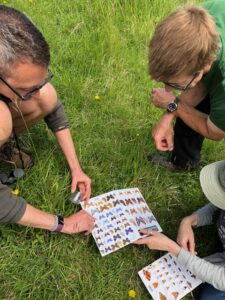
Identifying butterflies with fellow explorers
The day was delightful. The National Trust team could not have been more informative or helpful. Exhilarated, everyone left inspired and determined to return.
At the time, I had no idea that two months later I was to have an accident that would take away my ability to walk. Over the months since the accident, I have spent hours picturing the South Downs and remembering the feeling of running with a butterfly net. Almost daily I visualise walking on the Downs as I gradually strengthen my legs through physio. But Nature heals, and even as I sit on my bed, housebound, I am using my memories of being in Nature and my ability to write as healing tools. One day, I will not just visualise walking, I will walk and re-visit the butterflies and orchids. I will return to the Downs, and on my next visit I will be using a National Trust mobility scooter.
About Nina Thaddeus
Nina Thaddeus is the author of ‘I love to see you eat’, a self-published reflection of her mother’s Anglo Indian life from Karachi to Crawley. Born in Pakistan, her family immigrated to the UK in the 1950’s and settled in Sussex where Nina has spent most of her life.