

Some reflections on the Chattri and belonging
When I migrated to the UK 20 years ago everything was familiar and strange at once. My Sri Lankan heritage created a colonial connection that primed me in strange but deep ways to feel at home here.
So I didn’t expect the constant feeling of dislocation. I arrived in January, but the lack of warmth went deeper than the weather. I was regularly mistaken for a student, not a teacher, at the language school where I taught English. In social settings I encountered confusion, sometimes impatience – not curiosity – about the seeming mismatch of my face and my accent.
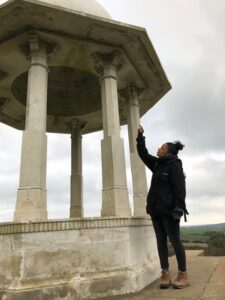
This loneliness accompanied me on my first visit to the Chattri. Alone on its green hill, I felt a kinship with it. Its former function as a funeral pyre meant I stood in the presence of the men cremated here, where they joined the elements I could still see, hear, breathe. Through the Chattri we were part of each other. I recognised the Chattri and felt, in its presence, recognised in turn, both of us strangers in this landscape.
But as I read about its history, the Chattri shifted in my mind from fellow traveller to symbol of colonial hierarchies. Its existence exposed the higher value placed on ‘loyal’ bodies of ‘worthy’ subjects over other racialised bodies whose sacrifice didn’t ‘merit’ a memorial of its own. The imperial logic inherent in the existence of the Chattri made me queasy.
And then I came across the letters. Letters written by Indian soldiers, which I first ead with a group of women writers of South Asian heritage. Reading, writing and walking with them soothed the rift which we all experience as descendants of formerly colonised people. To think about our lives, we have to hold a painful contradiction: our existence, however joyful, is the product of the imperial project. To paraphrase Sivanandan, we are here because they were there.
It wasn’t until later that I learned ‘chattri’ means ‘umbrella’ in Hindi, and noticed how the constant South Downs wind drops when you enter the bowl where it sits. Its shelter may be imperfect, but it is real.
***
A first Memorial Service
On Sunday 12th June I attended the Chattri Memorial Service for the first time. It was a clear warm day and I mostly ran uphill with my friend Kate to get there. We joined colleagues from Patcham Junior and High Schools and hundreds of others. The crowd around us was varied – many generations of Asian and white veterans wearing military medals on their uniforms and suits, families, dogs, single people. Everyone was dressed differently (shalwars and shorts, turbans and hats, suits and scarves) but here for the common purpose of remembering and honouring the dead.
Prayers in Gurumukhi and Hindi were followed by speeches and wreath laying. The sun warmed us, the breeze cooled us and my heart calmed after the uphill race. A skylark called insistently.
After the ceremony, I was astonished at the number of friends I saw. People I’ve known for a long time and have deep connections with, people I’ve met recently, people I recognise but have never met…here was a beautiful community, forged by the shared experience of coming together every year in honour of these men and their comrades. All of them.
 Most people made their way – by car, bus or on foot – back to the local high school for food. Not the tea and samosas I’d been expecting, but a delicious vegetarian feast followed by tea and jelebis, laid on by a Punjabi restaurant from Covent Garden and served by an efficient army of volunteers who kept the long, patient line moving with flashing ladles.
Older people and families with young children were served first, according to Sikh tradition. People of all backgrounds sat together, sharing tables and talking. Everyone was glad – proud – to be there. There was a beautiful generosity about the event that stays with me. Led by people of colour, it was a community event that met a deep need to gather, remember and connect. All credit to the Chattri Memorial Group for keeping it going – long may it continue.