Nina Thaddeus
Excerpt from "Awe and Orchids"
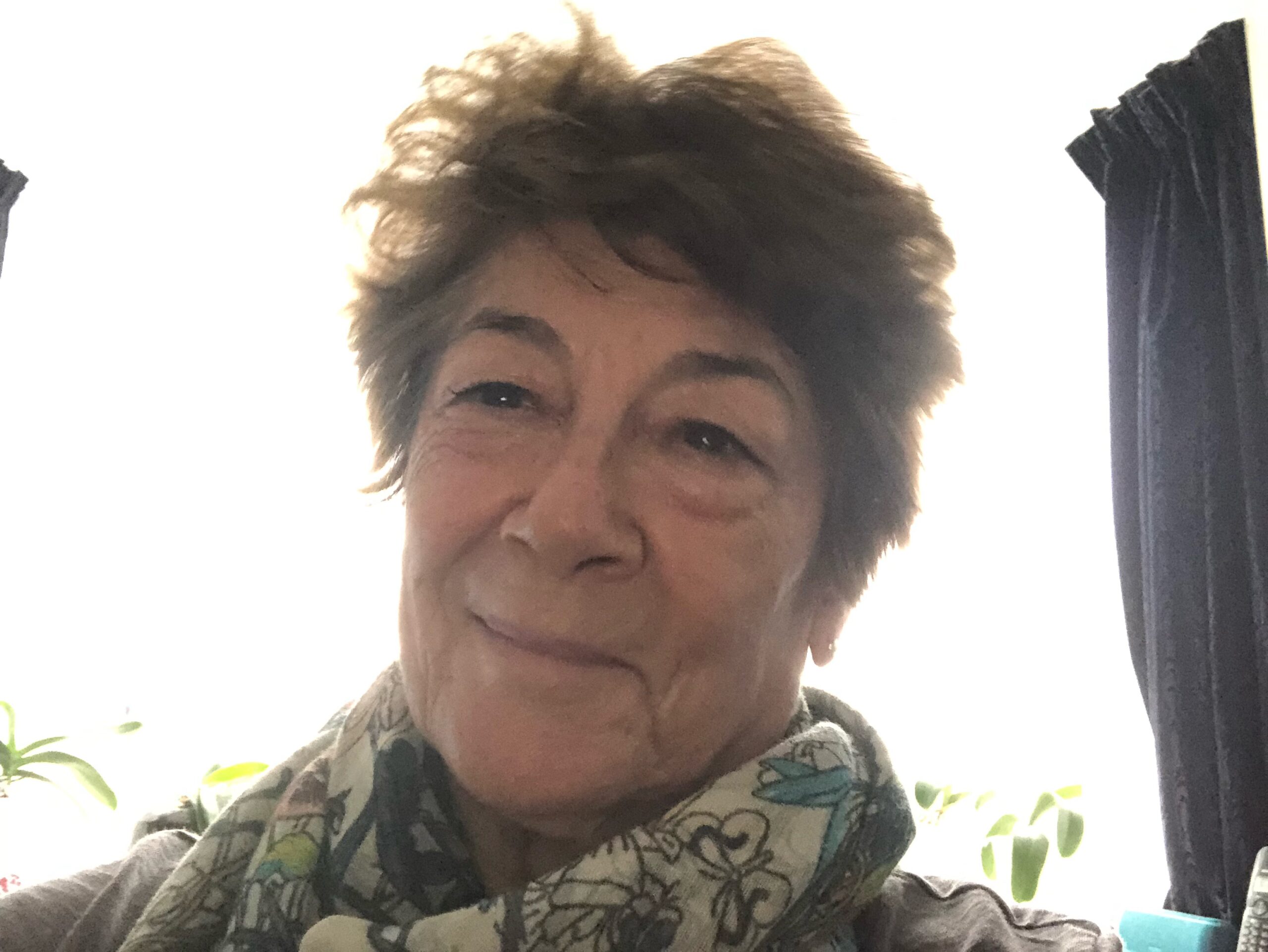
Nina Thaddeus is the author of ‘I Love to See You Eat’, a self-published reflection of her mother’s Anglo-Indian life. Born in Pakistan, her family came to the UK in the 1950’s and settled in Sussex where Nina has spent most of her life.
Her writing has been published in the Hidden Sussex Anthology and the first edition of Covert Magazine. Nina is passionate about the rich and complex landscape of the South Downs, and the restorative benefits of being in Nature.
Twitter @thadnina
Instagram @thadnins
Nina was one of the Covert Talent Development participants for 2022-23. This piece was published in Covert Issue 3 -- buy the magazine in print for £10 or digital for £5 from our online shop.
Published in Covert Issue 3
Awe and Orchids
Arriving at Birling Gap, a small coastal hamlet where the South Downs meets the English Channel, my spirits lift. Stepping off the bus, I glimpse sunlight breaking through the coastal fog. I stop and take a deep breath. The fresh sea air and sound of squawking gulls allow my body to soften and tension to melt, as if preparing me for the strenuous walk ahead. Smiling, I walk on.
My route will take me up and over the fragile chalk sea hills. Once I reach the meandering Cuckmere River, I plan to follow it inland toward Friston Forest. These hills, known as the Seven Sisters, were formed one hundred million years ago, during the Upper Cretaceous Period. Tropical seas covered this area, and as masses of tiny sea creatures died, their skeletons built up over millions of years to form chalk cliffs. Then, four million years ago, this region connected to France became flooded, creating the English Channel.
It is hard to imagine the vastly different landscapes that have evolved here though the geological periods. The land I stand on would have once been desolate, then thick clay and rock, and later covered in forest and coarse grass. One hundred and thirty million years ago, flower seeds, believed to be dispersed in the far east, arrived via strong winds, sea, and birds. Those that found the right environment grew and eventually evolved into the diverse, colourful flora that I see all around me today.
Reflecting on the impermanence of nature, I begin the climb. The chalk path with patches of compressed grass and rabbit droppings exhilarates and exhausts me in equal amounts. With legs getting heavy and cold sweat forming around my forehead, I stop to remove my jacket at the top of Baily’s Hill, the second of the seven named hills that I will encounter today. Looking outward, the seascape is stunning. With the curve of the shoreline, I see the white cliffs ahead emerging through fading mist.
Below, the sea rises, creating huge foaming tips, and with ease pulls away as if wanting to avoid the harsh greeting of the shore. The rhythm of the waves is somehow soothing, yet the dangers are real, which adds to the excitement I feel when high up, close to the sea cliffs with their beautifully rugged landscape. The same landscape that on a calm sunny day creates a softness that almost invites the visitor to take risks and move step by step, closer to the dangerously eroding edge. The views and sounds are a therapeutic distraction from the stresses of everyday life, and with re-energised determination I continue and reflect on what draws me here.
I first walked this path five years ago. I was going through a difficult time. A relationship breakup and caring for a dying mother were the drivers for me to take on the challenge. I felt confident I could do it, and with two friends much younger than myself, we set off to do the South Downs Way, in monthly segments, starting with the most difficult part. I vividly recall that foggy, damp morning in January and how I struggled. When ascending I walked sixty seconds and stopped for the same. Counting each second with sheer determination, and with each step telling myself ‘I can do it’. This became my motivational mantra and physical instruction. The ecstatic feeling once completed has never left me. Month after month we trekked across the Downs. Each month became a heart-warming experience and an unbreakable attachment to this landscape developed. Walking became my therapy, and the Sussex countryside my inspiration, proof that the joy and beauty of nature heals. We picnicked in the sun, laughed in the rain, and got lost in the Forest. The flora and fauna amazed, and the vast views over the towns and villages of Sussex never disappointed.
Yet, even with nature’s welcome, confidence in my sense of belonging was at times challenged. A sign marking Black Cap Nature Reserve, splattered with vile racist graffiti, proclaiming that the English Countryside should remain white, was a stark reminder that ‘The Countryside’, to some, is a place with borders. That not all are welcome.
Today the reward will be physical and emotional. It is spring, and I excitedly anticipate seeing a profusion of wildflowers, in particular the wild orchids that never fail to captivate my senses. I want everyone to feel what I feel when I see one of these amazing plants. As did my mother, when she bought me my first orchid flower in 1976. Born in India, she often described with enthusiasm the colours and shapes of the wild epiphytic orchids flowering from trees and vines near her grandfather’s house in the Himalayan foothills. In the mid 1970s, after twenty years in the UK, she found in Marks and Spencer a single orchid flower set in a small water filled plastic phial. Excitedly, she gifted me one. At first, I simply didn’t get this strange gift. But weeks passed, and the plant continued flowering. Eventually, it engaged my curiosity. I took a closer look, and, as if innate, the fascination began. Initially it was the brightly coloured, highly expensive, flowers that I occasionally saw in speciality florists or hotel lobbies. And then, quite randomly, I found a cluster of pale pink Common Spotted Orchids growing by a track in the South Downs. I was immediately in awe. I didn’t know of wild orchids and found myself compelled to stare and study these plants whose beauty often perfectly mimics the appearance of their insect pollinator. Masters of deception, one of their tricks is to put out the scent of false pheromones, thereby fooling a mate to pollinate. Their scent ranges from vanilla or sweet honey to rotting meat, and their range of mimicry is vast; bees, spiders, flies, wasps, moths, and butterflies are all used to cross pollinate the clever orchid. Even their name is intriguing. The word orchid is derived from ‘orchis’, the Greek word for testicle, because of the shape of the root tuber of some species.
Like many, I became struck by wanting to seek these alluring plants. But unlike the Orchidelirium of Victorian and Elizabethan Orchid Hunters, I do not voyage or steal or compete for the prize of possessing these plants. The orchids I seek are all settled here in the South Downs.
Plant Hunting has a fascinating and ugly history. Many plant varieties were ruthlessly torn from their very roots by colonial explorers. Orchids stolen from tropical forests were transported for weeks in packed ships to satisfy the whims and wants of wealthy collectors. Those that survived were sold for a high price and struggled to live in stately homes and botanical gardens. Kew received its first tropical orchid in 1760 and had two ‘hospital hot houses’ for sickly new arrivals. Queen Victoria, who it is claimed banned women owning orchids as they were too sexually suggestive, had an official orchid grower and employed twenty-three Orchid Hunters. In 1879 what is today Britain’s oldest commercial orchid nursery was opened near Lewes on the South Downs.
Orchid Hunting involved huge sums of money and was dangerous. Many were killed by wild animals, tropical disease, and those protecting their land. In 1901, out of a group of eight British hunters in the Philippines, seven died in gruesome circumstances. The survivor surfaced with a shipment of Phalaenopsis orchids known as Moth Orchids. With its tall green stems, elegantly curved leaves rising from the base, colourful circular outer petals, beak-like nose and extended lip, this is the most recognisable and best-selling commercial orchid in the UK today.
Approaching Went Hill the landscape descends and steeply rises. The grass on this national trail becomes smooth and soft. I walk away from the edge, closer to the fenced farmland that spreads inland. It is spring and I occasionally spot sheep grazing in the distance. Without grazing these chalk grasslands would return to scrub within around fifteen years and woodland within fifty to a hundred years, and the diversity of small plants and their companion insects would be lost.
Across the South Downs there are many endemic wild orchids. Unique to this area – they have cousins with distinct similarities growing in the chalk cliffs of France, but they would be classed as Non-Native or invasive if found here.
These words worry me. The ease and normalisation of these terms, long used to describe plants and animals, are also freely used to hurt, and create discomfort and division for so many.
I have often felt uneasiness around these terms. But never have I challenged them directly. As a white person of mixed-race heritage, I didn’t feel I had the right to do so, and if I did, I feared it would be seen as a comment on behalf of my mother, grandparents, or some other relative. At best, I feared I would be thought oversensitive or just uneducated in botanical terminology. I am not alone with this discomfort. Invasion ecology terminology is real and being debated. Thomas Halliday, palaeontologist and environmental biologist, writes in his book Otherlands:
“So it is, that even natural biological terminology, that of dispersal and migration carries with it an uncomfortable ring of political language. [...] The human imposition of borders on the world inevitably changes our perception of what belongs where. But to look into deep time is to see only an everchanging list of inhabitants of one ecosystem or another.”
Yet the seeds of the non-native continue to arrive, often displaced by the brutal destruction of their eco-systems. Orchids can produce between two to four million of the lightest of seeds. These are easily carried across continents by strong winds, often attaching themselves to birds, boats, or the clothes of unsuspecting passengers.
Finding land, they are challenged with seeking a place of stability and nourishment. Some will go on to towns and cities where they hide or try to reveal themselves in order to show off their unique attributes. But many will be drowned in rising oceans, burnt in raging forest fires, or just lost.
Every now and again, the very rare will be found and greeted with admiration. In June 2021, BBC news announced that thirteen Small-Flowered Tongue Orchids had settled on the roof garden of an international bank in the City of London. I remember that moment. Intrigued, I immediately stopped what I was doing and turned to the radio. The story was incredible. These once-thought extinct orchids were being praised for finding their own way here and immediately given the reward of a non-invasive status. It was later declared that they were to be recognised as native.
I was delighted, yet surprised that this story made it to mainstream news, which at that time was full of stories regarding small boats and the June 2021 record-breaking statistic of 125,000 asylum seekers – all awaiting processing.
The irony of seeds having more rights than humans was lost to the noise of the numbers. But beyond the jubilation of orchid enthusiasts, there were concerns. A spokesperson for the Linnean Society said, “While on one hand this is a very interesting event, there is a deeply concerning undercurrent, namely climate change. [...] And this is yet another example of the natural world responding rapidly to these pressures while we remain largely oblivious.”
In Britain, native plants and animals are categorised as those who have inhabited Britain since the last ice age. I learnt that day that more recent arrivals are ‘native species’ if their presence is not due to human intervention.
Arriving at Brass Point I feel invigorated. The green landscape ahead shimmers in the bright sun and I am grateful for the sea breeze across my back. With small steps and a forward lean, I begin to climb the fourth hill.
Each time I do this walk I search for signs of new seeds arriving on the winds of change. Wind pollination is common, yet seed dispersal as a means of plant migration is relatively rare. Many British wildflowers are relocating and moving north, so it is expected that European orchids will find their way here.
In March 2023 the Botanical Society of Britain and Ireland published a study announcing, ‘non-native plant species outnumber native flora’. The cause of this is climate.
As I walk toward Rough Brow the field beside me is full of familiar wildflowers and grasses which in the light breeze looks like multicoloured waves flowing and rising from the earth. I see no signs of plant increase, but the shoreline decrease is stark and disturbing. To my left is red tape and signs warning visitors to stay clear of the edge. Rock spills and falls have become common, as has the erosion of many narrow cliff ledges which are nesting areas for seabirds, including kittiwakes who are also suffering from the overfishing of sandeels on which they depend.
It is whilst out in nature that the biological interactions and dependencies of all life forms becomes more obvious. On a recent orchid and butterfly walk I was introduced to the Adonis Blue butterfly which has a fascinating symbiotic relationship with the ants that live in these chalk hills, and the delicate Small Blue, which only survives in areas where kidney vetch, its sole food, is found.
The orchids that day were abundant. As we walked toward a wooded area, a hill that is home to tens of thousands of Common Fragrant Orchids all in magnificent pale pink and purple flower, came into view. I recall excitement rising and my heart rate increasing as I approached these common, yet delightful plants that smell of their pollinating moth. This was only the appetiser. What was yet to come thrilled me, and I struggled to hide my rising anticipation.
Slowly we entered a wooded area in the knowledge that the grassy bank below hosts over twelve orchid varieties. This bank had for many years been left to become dense scrub. Then, a ranger met someone who told him that the bank, in their childhood, was full of orchids. The area was cleared and within a few years orchids returned.
Botanical lens in hand I carefully followed our guide. As my eyes adjusted, I saw thick grasses and many flowering plants and almost immediately spotted a Fly Orchid, which has the appearance of small wings extending out from its dark brown body and purplish belly. This clever mimic closely resembles the small flies it wants to attract. Minutes later I was distracted by the sight of a Twayblade Orchid, a visually less exciting orchid that requires a botanical lens to view its perfectly hidden features. To my left was a Butterfly Orchid. A beauty and prize sighting for me. This delicate orchid has a tall single flowering spike with whitish green flowers, and petals that spread out like butterfly wings to attract night flying moths. On it went: numerous clusters of seven types of beautiful orchids nestled amongst hundreds of wildflowers on a small grass bank in the South Downs.
The orchid seeds had survived underground. Like many plants once the area above is cleared, through acts of nature or mankind, the seeds flourish. The minute orchid seeds hold no nutrients. Survival depends on their symbiotic relationship with the mycorrhizal fungi in the soil they have settled in. This relationship is essential when the seed is dormant and in the early months of growth. It is still early days in the study of mycorrhizal fungi, but it is believed that around ninety percent of plant species form associations with it. This pleases me as it is becoming evident that the increase in theft of wild orchid plants is futile without the correct amount of mycorrhizal.
My walk continues, as I slowly climb Rough Brow. With the June sun now blazing, and the cascading, complex sound of lapwings in the distance, I stop to enjoy the sights, smells, and sounds. The sea glistens below. As I turn and look back, the view of the white chalk hills with their green tops becomes vivid. They rise from the narrow beach, their black Flint Bands announcing the story of their formation to the fossil collectors who gather here each year.
There are no people in view, yet I am surrounded by life and nature in all its glorious forms. Birds and insects, full of purpose, noisily getting on with their day.
Walking on, with all senses focused on the grass, a small chocolate brown circle almost hidden reveals a rare Early Spider Orchid. This is another example of a ‘sexually deceptive orchid.’ The dark velvety lip of the flower is furry on the outside and its smooth centre resembles a spider. There are many subspecies,each pollinated by a different insect including the solitary bee. This orchid emits a smell which mimics the scent of the female Buffish Mining Bee, thereby attracting the male of the species. It’s these facts, that make nature so interesting, amusing and just plain smart. As my eyes adjust, I notice these beautiful orchids are settled all around me. Hidden from the untrained eye, they are perfectly protected.
Happy, I wander toward Haven Brow and find a place to sit and absorb the beauty of the day. My body is exhausted but my mind is full of exciting thoughts. I find a comfortable spot and look out at the spectacular views. The sea sparkling to my left and Cuckmere Haven, the estuary of the Cuckmere River below. There are a few people relaxing on the shingle beach where smugglers once gathered. Seaford Head is directly in front with its iconic Coastguard Cottages clinging to the side of the frail cliff.
As I look down to the mouth of the river, I remember another type of seed found in the Estuary. The Sea-Bean or Drift-Bean as it’s often called are seeds which have travelled many thousands of miles, often for many years. Capable of crossing the Atlantic Ocean from the Caribbean or the coast of South America. A seed whose outer shell is created to survive for years in harsh salty oceans. Designed to float, they are one of the ways nature ensures the migration of plants and the survival of species who find themselves with the prospect of a new life in an unfamiliar landscape. Like the conker size seeds of the Monkey Ladder Vine that travelled from the Brazilian Rainforest to a beach in Dorset. Many tropical plants have diaspores – a plant dispersal unit consisting of a seed and other tissue that assists dispersal. Coconuts and other fruit seeds are regularly carried by the Gulf Stream to Europe. Many varieties of Sea Beans have been found here in Cuckmere Haven. These Sea Beans often find themselves in places that they would not naturally germinate and reproduce. It has therefore been generally asked within the Sea Bean Community, “What is their purpose?”
Pondering this question, I lay down on the grassy bank with the lowering sun shining on my smiling face and rest. As I close my eyes, I speculate on a future when this area of Sussex has returned to a tropical climate. A time when the Sea Beans that have been gathering for thousands of years, having been washed inland on the rising rivers, finally complete their purpose and bloom. The changed environment grants life to many dormant plant and animal species who will have adapted enough to live in this new ecosystem. I imagine heat, floods and fire clearing immense areas, and for a time everyone is a refugee. Eventually, the seeds left dormant from the Elizabethan and Victorian eras, and long destroyed orchid nurseries will grow, and thrive in a new tropical climate. With weather like the forest that their ancestors were stolen from, they will form new colonies of ‘exotic’ epiphytic orchids that grow on tall vines in Sea- Bean plantations. I envision a potential future when these shores welcome what is drawn to it without resistance. A time when nothing is invasive, and survival is solely dependent on finding a place to flourish. The lightest of seeds carried by the winds, the heaviest by the waves. Nature will find its way.
SUPPORT US
DONATE
SHARE WITH US
VOLUNTEER
SHOP