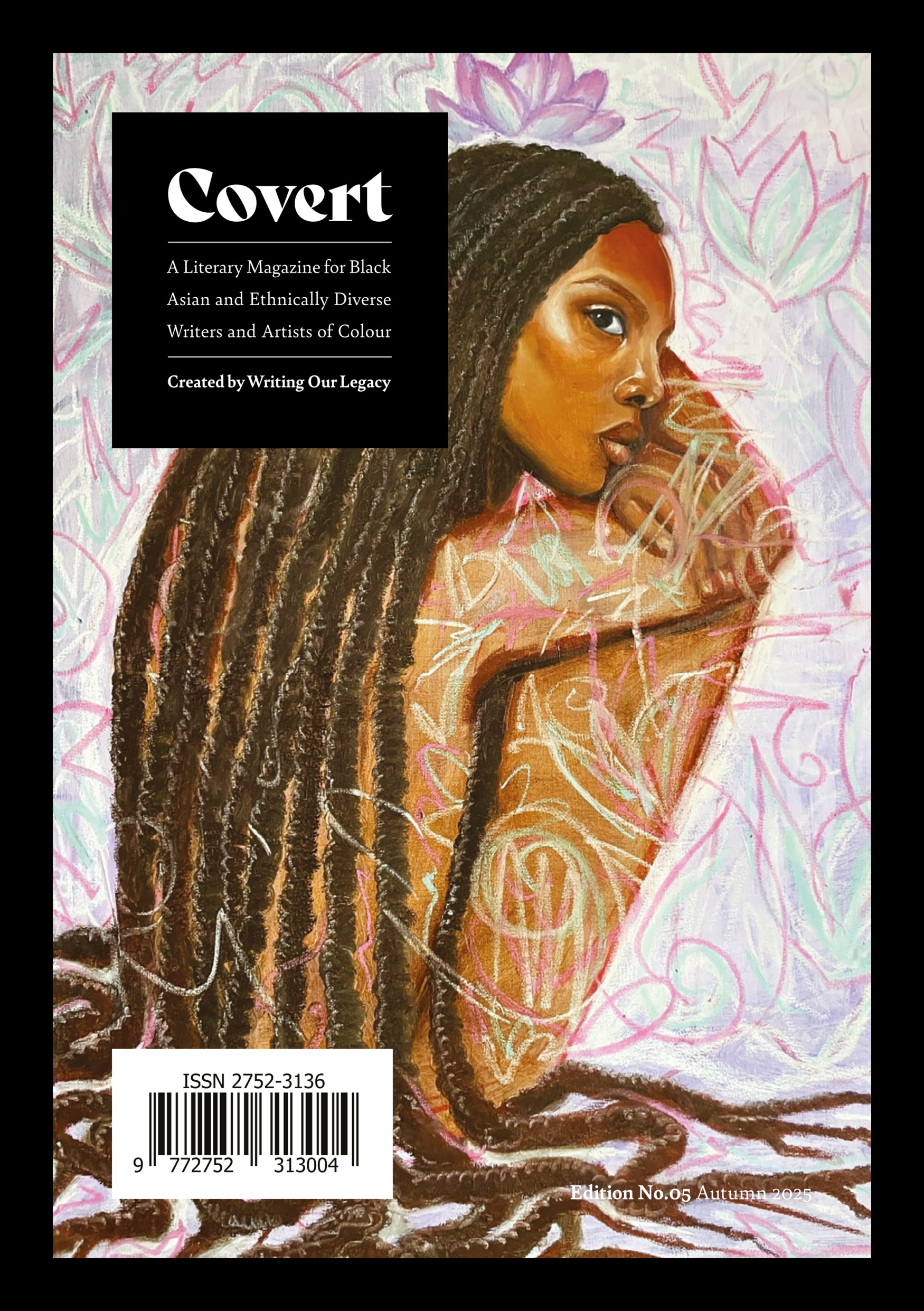
West Yorkshire-based British Pakistani poet and writer, Sheena Hussain, reviews our latest issue of Covert Literary Magazine. Sheena’s review is a Writing Our Legacy Creative Commission.
Watching 2025 nearly come to its full term includes having lost a dear friend to cancer and not achieving half of what I intended to. I can hear my inner voice scream—Rest Yourself girl, of course, the title of this literary magazine, which I feel is going to be like a long overdue dance with poetry, prose and artwork. Thus, a timely magazine not just for me, but for many, I’m sure. As I position myself to embrace its sumptuousness, I am excited to dive into the depths of the Autumn edition of Covert 5, knowing that ‘rest is radical self-care’, especially for us ethnically diverse people who work astronomically harder than our privileged-white counterparts. I am also a carer to my mother dearest, but for the next hour or two, I’m taking off the carer’s apron, and the DIY DO NOT DISTURB sign has been hung outside the lounge door as I speak.
Let me first begin with the two preludes by Guest Editors Akila M. Richards and Sea Sharp. Both offer a portal to Rest Yourself that pushes past the binary of merely lying down and taking a rest.
Akila Richards takes inspiration from her own practice, The Rest Experience, as a backdrop to invite what rest could look like post-COVID-19, the killing of George Floyd, Black Lives Matter and the ongoing global conflicts, especially genocide G. Rest provides us ‘a space to digest the/information and mend the cracks with the/gold of my iteration’.
Sea Sharp unapologetically is learning ‘the power of saying/No’— if only it was that simple! If you find it hard to put your finger on rest, then you ought to ‘look within’ Sea counsels.
Various readings can be made of what it means to Rest Yourself.
At the outset, I was drawn to a recurring theme of intergenerational trauma of our ancestors (both the knowing and not knowing) that inhibits the process of resting. But ironically, it is the place where we rest, in the space between heartbeats.’
Listening to our grandparents’ and parents’ stories is a fissure to our rest, but we are not our ancestors. A mother enforces her version of rest on her daughter when she suggests she goes for a massage, but realises she prefers to paint. When the roles are reversed, and children take care of their parents, their good intentions induce anxiety instead of rest. It made me think of how resting can be a double-edged sword, as it can trigger (un)rest in others.
A quarter of the way into the magazine, I decide to take a ‘Covert Rest Prompt.’ I chose number three, ‘When did you last sip some water?’ Suffering from a dry mouth after treatment some years ago, I must confess I don’t always hydrate. I find myself holding a glass of boiling water that has had time to rest. I watch it bend over as I shake the glass, trying to pin down a smell. Then I down it, in three gulps. A moment of gratitude fills my head, then it’s snatched away; I am transported to Gaza—when did they last sip? I swallow guilt; I pull on a quote by Sir Allama Mohammad Iqbal, ‘I die if I rest’. Death lives in the body of this collection more than once. In the poem ‘Grounding’ by Mabel Encinas-Sanchez, we learn the death of a mother committed to earth both derails the child yet brings them back on track. We are reminded ‘rest isn’t only for the dead.’
There is a jarring juxtaposition of the writing and artwork, perhaps to halt the pace. Maybe, a deliberate attack on ‘guilt grafted in our bones’ that so many of us harbour at the expense of ‘rest time’ (Tulika Jha). If we are lucky enough to catch rest, then it’s in between ‘…the endless list of domestic chores—just rest’ (Reema Kausar Majid).
Or in the Newspaper photograph by Jesmal Jalal, we hold up to our conscience and assert like a song of freedom, ‘REST is rebellion, reparation, resilience and resistance too’ (Sheila Auguste). Thus ‘real rest should not feel like a capitalist duty’ (Erin James), and when it does, find ‘fresh bed linen ginger/tea and rest in between’ (Alice Motta). But to thrive in a world that constantly demands of us, we need to slow down, which is both disruption and resistance as it pushes back white supremacy and capitalism, what you could call, Politics of Rest, a photograph by O S King.
As I begin to leave the belly of the magazine, I am made to feel like the A Broken Armrest photograph (Jesmal Jalal): though broken, still resting in the complexity of its rootedness, doing nothing. This reminded me of the Dutch concept of niksen I came across a few years ago. Sitting with nothingness essentially means there are no outcomes. Outcomes, of course, are the bane of our hectic lives and often, the body will take a battering, and our wellness becomes something we don’t recognise, so why then won’t we Let the Good Girl Rest? (Jackie Mendoza)
This incredible body of ar-resting work is one for your bookshelves. It has everything from lyrical to hybrid writing. I can see it being pulled off the shelf repeatedly, especially when the urge to rest arises. A collection that helps reimagine what rest can mean. It doesn’t/mustn’t stop at the page.
Rest is rooted deep in the intergenerational trauma (s) we carry; it is long and painful, yet ‘why are we so quick to wipe pain away?’ Instead, we must live and sit with it. If we don’t know what our rest looks like, how then will we know what it feels like in the fissures of our melanin skin? This is powerful, raw, electric writing of rest legacy. ‘Rest is a movement inwards’ (Dr Tulika Jha), echoing a motif that Sea Sharp lays down at the very beginning. Let us all be part of it, and I pay homage to those who birthed it.
Right, I’m off to have a nap!
Covert Literary Magazine Issue 5/Autumn 2025 is now on sale, with print for £13 and online starting at £5.99. This edition, co-edited by Akila M. Richards and Sea Sharp, invites us to reimagine what rest can mean, bringing together a selection of work by 33 powerful voices. For more information, please visit our online shop.
About the writer
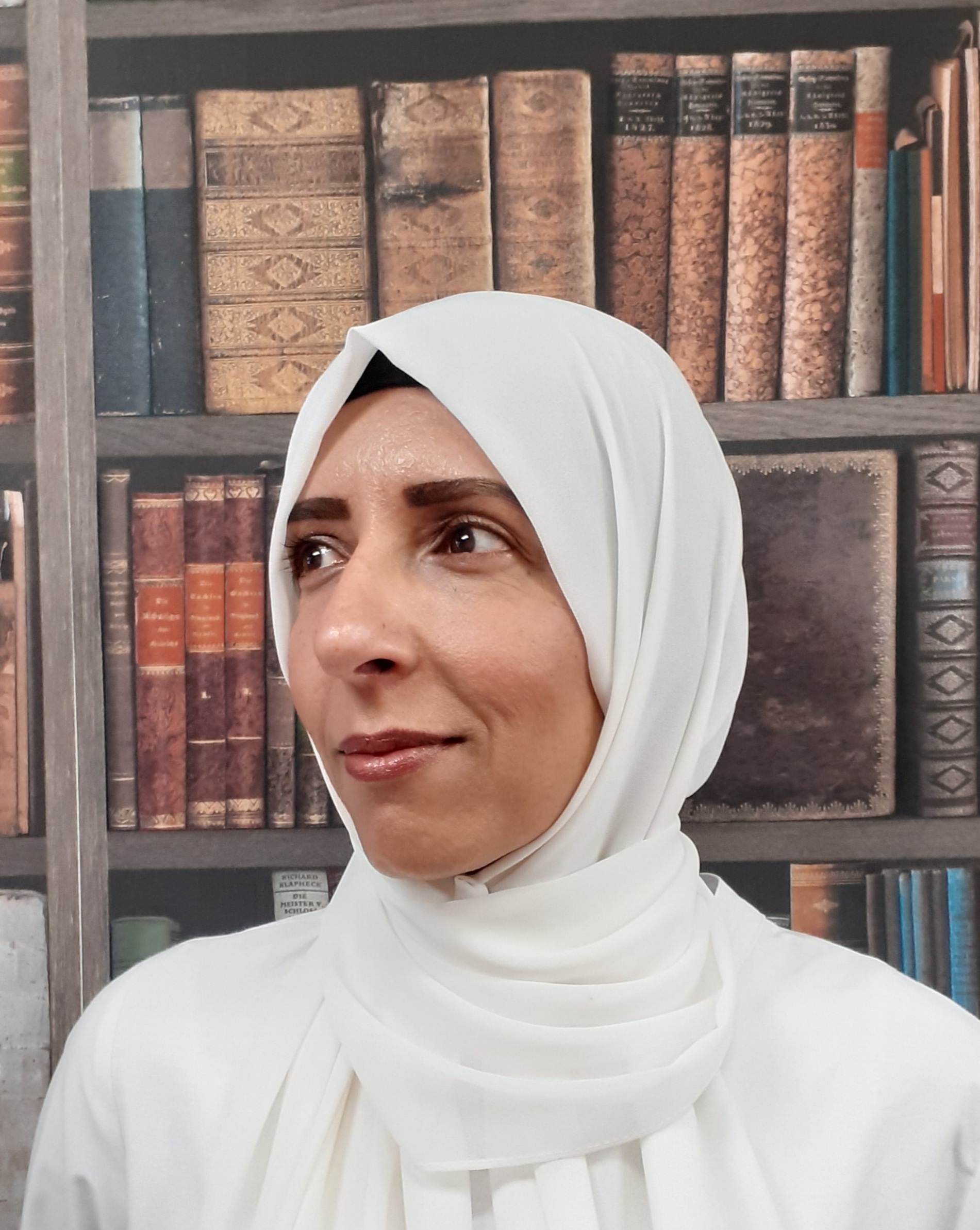 Sheena Hussain is a British-Pakistani former lawyer turned poet and writer based in West Yorkshire. She turned to poetry after a cancer diagnosis. She freelances and cares for her mother. Her work tends to concentrate on adversity and resilience from a brown working-class lens.
She is widely anthologised and published in several journals, including Renard Press, Peepal Tree Press, Swerve Magazine, and The Storm, to name a few. She was longlisted for the Leeds Poetry Festival Competition 2022. Her creative non-fiction was shortlisted for the inaugural Curae Prize 2023. Shortlisted for Building Bridges Competition 2024. Shortlisted for the Creative Future Awards. In the same year, she was commissioned as a New Northern Poet by Ilkley Literature Festival.
She is the founder of Poem:99, an international children’s poetry competition which is in its eighth year. She is a member of Peepal Tree Press Readers & Writers Group. When not writing poetry, you will find her taking long, solitary walks. She is an avid snooker fan.