Writer and Youth and Community Worker Nina Bhirangi-Bishop joined a Writing Our Legacy Creatives’ Network trip to Chichester to see a new show in development, The Brown Ranger by Ben Grant. Here’s what she thought.
Stepping into Chichester Festival Theatre’s studio space, The Nest, I felt the buzz of hopeful promise that comes with the opening of a new and innovative venue. Promoted as a home for “fresh ideas, new voices, and the showcasing of local creative talent,” it seemed the perfect setting for Ben Grant’s new solo show, The Brown Ranger.
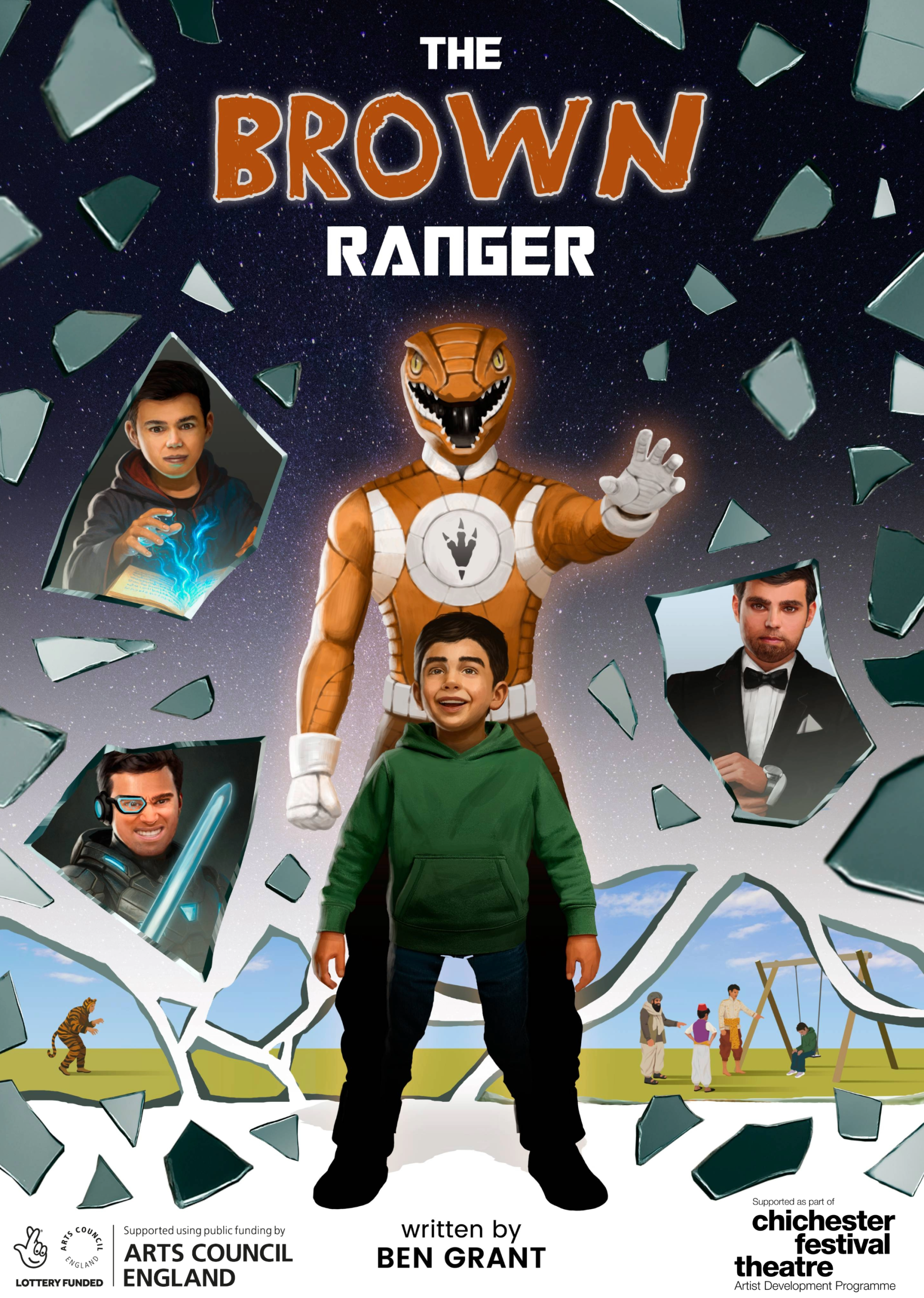
Developed through the theatre’s Artist Development Programme, Grant’s piece is contemporary, deeply personal, and steeped in the nostalgic neon glow of ’90s pop culture. It’s an evocative ride, underpinned by a narrative with depth and vulnerability. At its heart lies a coming-of-age story about Thomas, a mixed-heritage seven-year-old, who navigates a fictional realm where strange “glitches” distort his reality and force both protagonist and audience to confront challenging issues, including representation, identity, and belonging.
Thomas, our pint-sized protagonist played by Grant, inhabits that uneasy space between child and young adult, showing us both who he was and who he has the potential to become. Thomas escapes the realities of his world through imaginative play, favourite cartoons, and his beloved characters; the Power Rangers. After a playground incident of peer-on-peer bullying, Thomas is compelled to face the realities of being of mixed heritage. Beneath it all are insistent questions of identity and inclusion. Forced to confront the absence of representation around him, Thomas begins to embody his own cultural hero: the Brown Ranger.
All this is set against a backdrop of an eclectic and vibrant original score by Zygmund de Somogyi and imaginative, immersive video production by Douglas Baker, which draws us inescapably deeper into Thomas’s world.
It is in this tension between “Britishness” and “belonging” that the play finds its strongest message. However, at times, the power of these moments didn’t quite land for me, and the production lacked the grit and urgency that might have elevated it from good to great. Still, the ambition and relatability of the piece kept it compelling.
As a British Indian gal who grew up in the eighties, some of the play’s key incidents resonated with a deep sting of overfamiliarity. I remembered how my white British friends could pull off a better bhangra to Punjabi MC – one of the songs featured in the show – than me, or the times I was also nicknamed “coconut”, or more specifically, a “Bounty bar”, by Asian friends who seemed more elusively “authentic” than me. The park incident in the play echoed an afternoon from my own childhood, so much so, I could have penned it: I was sat on a swing with my best friend when a group of boys surrounded us, taunting me with jokes about starving Ethiopians. This was about the time Band Aid had been released. For me, it was the painful moment I realised that my non-whiteness marked me out, and that Britishness, as it was then, simply didn’t belong to me.
In terms of representation, my own childhood also bore the sting of absence, as it does for Thomas within this piece. As on TV, the Power Rangers offered no brown hero for him, in my local toy shop, there was no brown ballerina doll for me to pick out and play with. Only now, forty years later, have I bought my first pack of tan-coloured plasters, never mind having the appropriately skin-toned ballet shoes or tights that I didn’t know I longed for, way back then.
What also struck me was the proportion of people of colour in the audience that afternoon. As a member of the WOL group, I count myself among them, and it was refreshing to see more than just us, as brown faces in theatre spaces. My hope is that pieces like The Brown Ranger will continue to open doors to greater diversity, not only in the stories told on stage, but also in the audiences who come to see them, and it’s heartening to see CFT providing a new space and platform for this.
It is with Grant’s bravery, vulnerability and introspection, and the kind of attention to detail that made me lean in closer. Grant’s work lingers – full of the promise and possibility of a piece that not only resonates in the moment, but hints at even greater things to come for both its creator and the stories it champions. Ultimately, The Brown Ranger stayed with me, and I found myself still thinking about it all the way home.
About the w riter

Nina Bhirangi-Bishop is a Youth & Community Worker with a background in Performing and Youth Arts. Since moving to Sussex in 2005, she has combined her professional work with raising her family, while continuing to nurture a lifelong passion for storytelling.
Recently, Nina has been rediscovering performance and creative writing, contributing to Covert Magazine (Issues 3 and 4) and as part of Writing Our Legacy’s Talent Development Programme (2024/25). Her monologue Fallin’ Angels was produced and performed by Pitchy Breath Theatre Company on tour (Crawley Hawth/Capitol Theatre, April 2024). She also wrote a biographical article, From Burnout to Balance: A Personal Journey of Insight & Enlightenment, for Flourish Magazine (Issue 4, 2024).
Nina was recently invited to pitch a piece to Chichester Festival Theatre for the opening of their new space, The Nest, and was delighted to be asked by WOL to review Ben Grant’s The Brown Ranger at the new Nest venue.