
Writing Our Legacy was pleased to bring several of its Creatives’ Network members to the tenth edition of Photo London 2025, which took place from 15–18 May 2025 at the iconic Somerset House on the River Thames. This landmark anniversary brought together an incredible community of galleries, artists, collectors, curators, and photography lovers from around the world, with 131 exhibitors from 21 countries worldwide. Writing Our Legacy Creatives’ Network member Mbeke Waseme writes about their experience at this year’s Photo London.
The Photo London show is one of the biggest events on the calendar for photographers. It is an annual event that offers a wide range of photos from some of the ‘best galleries across the world’. These terms are subjective and must always be questioned and challenged in a world where the practice of photography and earning a living from this continues to be based on your income and class position. Yes, your talent is important, but we all know talented artist who are unable to eek out a living from their art and must succumb to some menial employment option to ‘make ends meet’. Knowing this, I went along to meet Amy and see what I would get from this event.
In this day and age, when so much is available online, why would we need to go to a gallery, be around other people, where wine is served with lovely vegan and vegetarian options in the on-site cafes? Why not just stay at home and cruise through TikTok and Instagram, where there were bound to be posts about it? Well, that is it. We all have some memory of the pandemic where freedom of movement was drastically restricted. The pleasure of photography is certainly to see it and to be in the room. Seeing the images where some were large and framed (with and without) glass, set against different coloured walls and covering a diverse range of topics, this is where the pleasure comes from.
On a bright sunny Friday evening, I made my way to Somerset House and entered a space where initially, I saw two people of colour, one man and one woman. The handsome black man who caught my eye wore a lanyard to show he was working at the event.
I wandered around the galleries, having my senses tickled. A photograph is never just a photograph. The size of the image matters, and some photographs were so large that I felt I could enter the space and feel the story that the photographer was presenting.
Other displays showed a series of images with clear connections in form and colour. Colour can be a hot topic for photographers. There are many professionals who do all of their work in black and white, whilst others only work in colour. Both bring their distinctness to an image, as you can see from these examples. The woman in the green tights and glasses and the close-up of the feathers sprinkled with green plants work beautifully in colour.
Some photographers challenge our ideas of what is acceptable. This included the Buddhist hanging upside down, whilst holding the prayer position. Are they supposed to do that? I heard someone ask. I am grateful for my work and travel experience in Malaysia, Thailand, Vietnam and Cambodia, where I have seen Buddhist monks in real life, having real fun.
The images of Global Majority men and women were minuscule, considering this is a global exhibition. Global Majority people make up 85% of the world’s population. You would not believe this going across the space and floors of this exhibition. Most of those on display in this exhibition came from ‘tribes’. Really, in 2025? Are we not all from one tribe or the other? When the term is only used with Global Majority people, it has a distinctly negative connotation of ‘less than’. The image of the young girl with a red flower headdress from the ‘Suri tribe of Ethiopia Omo Valley’, by a woman photographer who describes this young woman as ‘resilient’. I wonder if she has ever considered the connection between colonial bodies and the life of this young woman. I pondered for a while as I looked at another black woman with white marks on her body, which were there to show the terrible experiences she had had, and again, that word resilient came up as the curator photographed me with this image. The ongoing work for equity is also about how Global Majority people are depicted visually, on the screen and in all the spaces where people can be presented.
The exhibition allows any photographer to see how images can be displayed. This includes types and thickness of the frame. The type of wood you use and how it matches with the image. The background colour of the walls where the images were placed was important, and the size of the print mattered. There were ample examples of black and white, colour contemporary and experimental/abstract images. All of these can support the development of a personal practice and give life to ideas for solo and group exhibitions.
Each photograph is a millisecond. It can capture a person, a scene, a country, and we, the audience, can give it meaning. It was great to see iconic images of Muhammed Ali and to bump into the great photographer Thabo Jaiyesimi whom I captured with Naomi Campbell.
The exhibition displayed a tiny selection of images of Global Majority people, virtually no images of large-bodied people, older women or black families, even in the tribal settings.
With all that said, I encourage people to see what the world is calling ‘great photography’ and to create your own, with and without these influences.
About the writer
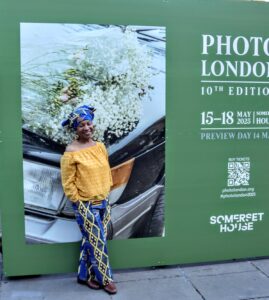 Mbeke Waseme is a renaissance woman whose creative expression spans poetry, short stories, photography, and cultural commentary. She is the author of three published books: How to Live, Work and Thrive Abroad (2023), a practical and reflective guide for those navigating life across borders; Exploring All of Me, a poetry collection delving into the layers of self; and And Then It Was 2020, her second poetry anthology, which captures the uncertainty, grief, and resilience of a historic year. Her work has also been featured in several anthologies, including Black and Menopausal (2023), This is Us: Black, British, and Female (2019), and Trusted Black Girl, edited by Roianne Nedd (2018), where she contributes to critical conversations around race, gender, and professional identity.
Mbeke’s short stories and poems have appeared in various literary journals such as Fifth Estate, Dovetails, Pure Slush, Home, The Writers Café, and publications by Flexible Publishers. Her essays and academic work have been published in platforms including Pambazuka, 72M and Anastamos. Mbeke’s poetry recordings in 2020, entitled “We Women Who Travel” and “Hold Me”, were both created in collaboration with Xolo Spkg and featured on the project The Unravelling Soul – Part 1 (2021), further expanding her storytelling through voice and sound. In 2025, Mbeke was commissioned to write an episode of The Wandsworth Way, as part of the Wandsworth City of Culture’s year-long celebration. Her episode centres on Val, the Irish mother of the main character, while also highlighting the stories of Caribbean women who migrated to the UK in the 1950s to work as nurses in the NHS.Through this narrative, Mbeke offers a nuanced portrayal of interwoven migration histories.
Her current creative focus includes a short documentary based on the lives of children from the Windrush generation, who were born in the UK and who have since relocated to Ghana, Jamaica, and Florida. The research and development for this work was made possible from the DYCP (Developing Your Creative Practice) grant from Arts Council England, awarded in 2023. This documentary is due for completion in 2026.
Mbeke’s work is as expansive as it is intimate, drawing connections across continents, generations, and disciplines. She continues to be a voice in conversations around cultural memory, diaspora identity, womanhood, and artistic resistance.