
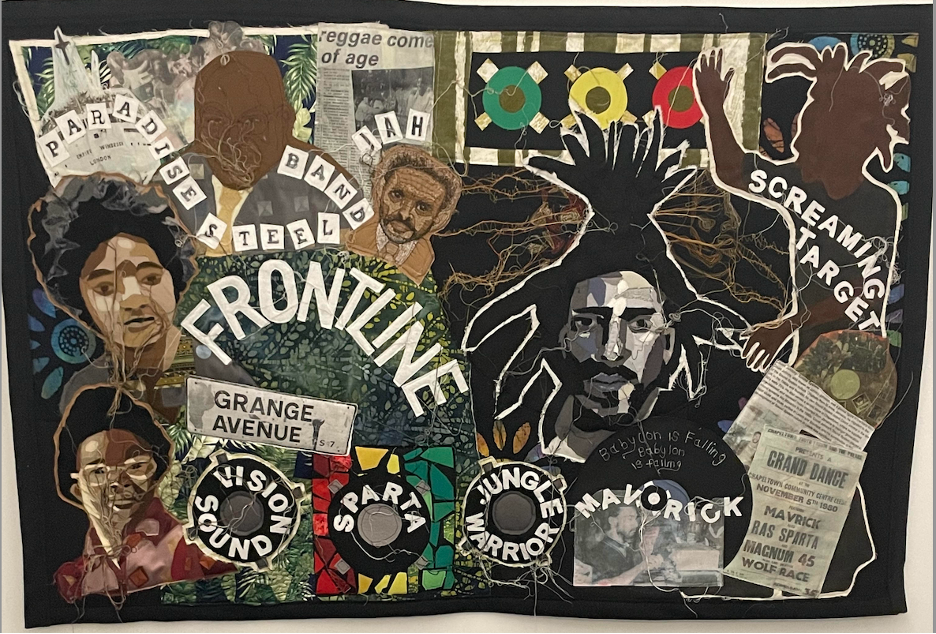
Newly arrived in London, Muhammad Ali Bandial jumped at the chance to visit Beyond the Bassline at the British Library with Writing Our Legacy, where he unearthed “hidden gems that hold the history of entire generations”. Muhammad is a member of Writing Our Legacy’s Creatives’ Network, and his review is a Writing Our Legacy Creative Commission.
Melodies have woven a deep cultural thread in my life growing up in Pakistan, where songs and lyrics carry the weight of family histories, blessings and prayers. Whether at weddings, celebrating a new birth, or marking Independence Day, every occasion has its song, passed down through generations, binding us to tradition and memory.
When I moved to London last year with my family, I was unnerved by the absence of a symphony in our lives. It was a balmy summer evening in London when I finally realised what our new lives were missing. It was the sound of music. I was reminded of the words of the great French Romantic poet, novelist and dramatist Victor Hugo, who said: “Music expresses that which cannot be said and on which it is impossible to be silent.”
I had been grappling with the concept of home and how one maintains a link to one’s roots after crossing oceans when my ten-year-old daughter, who was missing her cousins and friends the most, alerted me to the sounds of music coming from outside our house on Talbot Road. It was my first experience of witnessing the Notting Hill Carnival, a window into the rich tapestry of Black British music.
Black British music was a completely new and unexplored area for someone like me, who considered themselves a bit of a music connoisseur. So when the opportunity to visit the Beyond the Bassline exhibition at the British Library and explore 500 years of Black British music history and the journey of African and Caribbean people in Britain came up, I grabbed it with both hands.
I have always considered music a time capsule. It encapsulates the era, informed by social, economic and political ethos and pulse, while continuing to evolve and grow with time. The invisible threads that tug at our heart were highlighted by Susan Sontag when she said that music is at once the most wonderful, the most alive of all the arts. It is the most abstract, the most perfect, the most pure — and the most sensual. I listen with my body, and it is my body that aches in response to the passion and pathos embodied in this music.
Before visiting the exhibition, I brushed up on my knowledge of the history of Black British music. The exhibition is curated by Dr Aleema Gray at the British Library in collaboration with Dr Mykaell Riley at the University of Westminster. It highlights how little the general public knows about and appreciates the cultural influence of Black communities in the UK. I’ll be the first to admit that until that day, I had not known much about the lives and contributions of pivotal figures such as Ignatius Sancho, the 18th-century composer, and Dame Shirley Bassey. Key moments in the evolution of musical genres like calypso, jazz, grime, and jungle were also brought home to me.

The exhibition featured more than 200 items, including letters from Sancho, a 1970s outfit worn by jazz singer Patti Flynn, Steel Pulse’s KKK-style hood, a Nokia 3370, early grime photography by Simon Wheatley, and footage from the MOBO Awards. You know when you sift through old trunks in the attic and unearth hidden gems that hold the history of entire generations? That was the feeling I had when gazing upon these objects telling the stories of Black British music’s evolution – from Lovers’ rock and two-tone to jazz, reggae, jungle, Afroswing and beyond. They said so much, highlighting the genre’s role in celebration, protest, and continuous transformation, underscoring its enduring importance.
Iconic figures like Bob Marley, Stormzy, and Joan Armatrading provided a familiar entry point for many. It explored the evolution of Black British music, highlighting vibrant social scenes and memorabilia from key venues like Manchester’s The Reno and London’s Soho jazz clubs. Not limited to historical items, it also included contemporary pieces like Jamal Edwards’s video camera and Stormzy’s Glastonbury set. The exhibition served as both an introduction to, and a celebration of, Black British communities’ musical and cultural contributions.
When I first read up on the history of Black British music, I was amazed by the scale the exhibition hoped to cover. It is no mean task to skillfully balance the influence of commercial artists with the importance of grassroots initiatives, highlighting the role of carnivals, community centres, record shops, and other venues in nurturing different musical genres. But I needn’t have worried. Gray and Riley created a diverse and inclusive exhibition, offering something for everyone, from striking displays of record covers to fragile written documents. I was captivated by the comprehensive and approachable exploration of a vast musical landscape.
As with all great stories, the exhibition started at the beginning of Black music on British shores. The first section is ‘The Ocean’, covered the first 400 years of Black British music history, focusing on the early influences and movements and setting the stage for the more dynamic aspects of the exhibition.
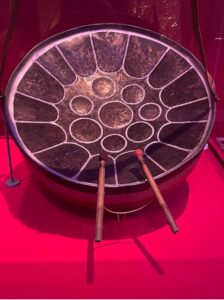
It opened with a 1512 account of John Blanke, an African trumpeter who served in the Tudor royal courts. Blanke’s origins remain uncertain, though he may have arrived in England with the Spanish Moors. He was not the earliest Black musician in Europe; Henry VI had black trumpeters in the 12th century. Nonetheless, Blanke is the first portrayed visually and recognised by name. He was highly esteemed by Henry VIII, receiving a generous wedding gift and successfully petitioning for a pay increase and enhanced status after a senior trumpeter’s death.
The exhibition’s second theme, ‘On Stage’, covered cultural influences on Black British music from the 1880s to 1960s. It highlighted key moments such as the Fisk Jubilee Singers introducing spirituals and the Southern Syncopated Orchestra bringing jazz to Britain. A major turning point was the 1948 arrival of the HMS Empire Windrush, significantly shaping British popular music. This era was vividly captured in the exhibition, featuring a notable clip of calypso legend Lord Kitchener performing London is the Place for Me upon disembarking the Windrush.
This section highlighted the Soho clubs that were hubs for Black talent and immigrant communities. For example, the Shim Sham Club on Wardour Street faced criticism for its diverse and inclusive atmosphere, reflecting early forms of social backlash.
The theme of ‘The Frontlines’ focused on the 1950s to 1980s, tracing British Black music’s continued evolution, including the establishment of the Notting Hill Carnival, and the rise of ska, bluebeat, and reggae. This era also saw cultural responses to racism, such as the Rock Against Racism movement and the creation of 2 Tone Records.
A section called ‘In The Record Shop’ explored the sense of belonging fostered by key music venues and record labels, emphasizing the spread of music from Jamaica to London and beyond, while celebrating Britain’s specific contributions, such as lovers rock.
The final theme, ‘Cyberspace’, highlighted the evolution of British music genres, including jungle, drum and bass, grime, UK garage and drill, which continue to thrive beyond the illegal airwaves and virtual spaces.
The exhibition concluded with a commission titled iwoyi: within the echo. The film installation immersed visitors in a deeply atmospheric, dimly lit space. Directed by Rohan Ayinde and Tayo Rapoport in collaboration with the London-based music label and community, Touching Bass, this piece took the audience on a non-linear journey. It began with the tangible elements of concrete and hardware, gradually transitioning into a more abstract realm of cosmology and spirituality. It offered a profound and contemplative experience that tied together the exhibition’s themes.
Moving between eras can sometimes be jarring, and the effect can leave the visitor disoriented rather than engrossed. The exhibition avoided this admirably, seamlessly connecting past and present by incorporating newly commissioned works that highlight contemporary themes and future perspectives. Through written artefacts such as postcards, sheet music, diaries and letters, we were taken on a musical journey, encapsulating the evolution of Black British music. The displayed items were complemented by materials highlighting how music intersects with other fields like fashion, art, design and more, reflecting its role in cultural and political spheres.
Other exhibition highlights included a film by Roundhouse Young Filmmakers, enhanced by Friendly Pressure’s custom-built sound system for an immersive experience. Mosaics inspired by Rastafari culture and a textile piece celebrating resistance in Leeds provided strong cultural insights. The Jukebox Collective’s striking blend of dance and moving images, displayed on suspended fabrics along the South Wales coast, added visual depth. These elements kept the exhibit engaging, connecting history with contemporary art.
The exhibition’s photography vividly captured the late 1970s and 1980s British cultural zeitgeist. These images featured everything from candid personal snapshots to club posters, T-shirts, and record sleeves, embodying an improvised British style. Notable contributions included Pauline Black’s trilby hat and works by Errol Lloyd. The exhibit also showcased a collaborative film and sound installation by Tayo Rapoport and Rohan Ayinde with the music collective Touching Bass.
I was overwhelmed by a sense of history and scope as I left the exhibition. Beyond the Bassline was comprehensive, leaving no aspect of Black British music and culture unexplored. It covered sound system culture and the influence of African rock (including Fela Kuti’s London education). It highlighted key figures like Dennis Bovell, Winifred Atwell, Poly Styrene, and Pauline Black. It also acknowledged the contributions of Soul II Soul, Gabrielle, Stormzy, and the MOBO Awards. Most notably, Beyond The Bassline stands out as a Black-led initiative, distancing itself from the common narrative of Black history being curated by white institutions. The program proudly declared, “Our story and our music begin in Africa…”
The exhibition offered a powerful opportunity for both Black and non-Black attendees to gain and share knowledge, enriching themselves with the profound legacy of this remarkable music and culture. Most of all, the exhibition gave me hope, a sense of belonging, and empowerment.
ABOUT THE AUTHOR | Muhammad Ali Bandial is an award-winning author, writer, editor, and former bureaucrat whose writing has appeared in The Friday Times, The News, Khaleej Times, DAWN, and more. He is a Faber Academy alumni and holds a Master’s in Public Administration from the Lee Kuan Yew School of Public Policy at the National University of Singapore. During his time in the civil services of Pakistan, he held several positions, including Assistant Director of Extremism at the National Counter Terrorism Authority and Deputy Director of Trade Policy. Born in Lahore, he lives in London with his wife and daughter.
***
Sharing your news Are you a member with a recent creative achievement that you want the world to see? Writing Our Legacy has thousands of followers across multiple platforms, and we want to help get your work in front of them. Whether it’s a published piece of work, upcoming performance or a residency, we would love to share your news with the world. Just fill in this WOL members news submission form any time.