Jose Hall visited Beyond the Bassline at the British Library shortly after returning from a trip to Jamaica, where she stayed with the parents of the exhibition’s lead curator, Dr Aleema Gray. She shares her responses to a show that explores the “connecting and liberating powers of music and sound” within the Black British experience. Jose is a member of Writing Our Legacy’s Creatives’ Network, and her review is a Writing Our Legacy Creative Commission.
Back in spring 2024, I was in Jamaica, staying in a blissful home with simple, soulful decor and a front door just steps away from a stunning river and luscious landscapes. My hosts were straight out of a half-Jamaican-Brit-solo-travelling-fantasy – a Rasta couple, with huge hearts and great taste who fed me delicious ital meals, kept the tunes playing and chats flowing.
One evening watching fireflies, they proudly told me about their children – all currently living in England – including Dr Aleema Gray, a public historian who was the lead curator of an upcoming exhibition about Black British music. Shortly after my return to England, they sent me a link to the show, Beyond The Bassline: 500 Years of Black British Music, at the British Library. Fast forward to the summer, and I hadn’t yet figured out a plan to go to London and see the exhibition, so I was thrilled when a group trip from Brighton was organised by Writing Our Legacy (WOL), Brighton & Hove Black History and African Night Fever.
Beyond The Bassline did not disappoint. As I moved through the different sections of the “musical journey of the Black diaspora in the UK”, I felt some of the same energy – simple and soulful, creative and caring – that I felt in Jamaica, in that house by the river.
The journey began in ‘The Ocean’. This first section, covering the 1500s to 1870s, treated us to some beautiful sonic and film pieces inspired by water, identity and migration. Later, I read in Dr Aleema Gray’s curatorial reflections that starting the exhibition in the ocean was “a way to confront the tensions associated with Black Britishness”, and I felt these initial expressive pieces doing just that, in a way that felt empowering and supportive of the ancestors within me, who were taken on that infinitely impactful journey across the Atlantic ocean. This section also covered rhythms such as Nyabinghi drumming, spiritual vocalists The Jubilee Singers and a book of letters by composer and abolitionist Ignatius Sancho.
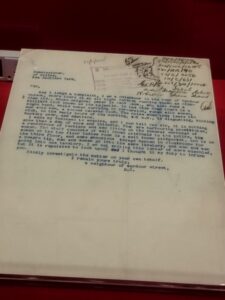 From there, we moved into ‘On Stage’ (1880s-1960s). The intro text ended with, “We are here. And we have a right to be here”, and I felt that sense of confidence and optimism throughout this section – including a celebration of the success of Black women, in particular, within the 20th century British music scene. We were able to get up close to dresses worn by both Patti Flynn and Adelaide Hall, as well as peek into the wartime scrapbook of Evelyn Dove, the first Black singer to appear on BBC radio, in 1925. We also got a glimpse into the underground scene that was kicking off in Soho at that time, in venues such as the Shim Sham Club, which first opened in 1935. I would have loved some kind of virtual reality here, because the Shim Sham Club sounded like a real good time! It was known for its “diverse crowd of Black, white, mixed-race and queer clientele”. The complaint letter to the police from a local resident was an entertaining (and eye-roll inducing) read.
There was so much more to listen to, look at and absorb throughout the next two sections. At times I wished there were fewer people in the exhibition so I could get closer and spend more time with some of the sounds, items, films and art. At one point, I witnessed a white man leaning, legs spread, with one foot up on one of the film-viewing seats – perfectly comfortably taking up as much space as he possibly could. Later, another black woman on the trip and I spoke about the feelings of discomfort that can come up when trying to engage with our histories over the shoulders of white people, and wondered together if it was extreme of us to wish we could view the exhibition at a time exclusively put aside for the Black community.
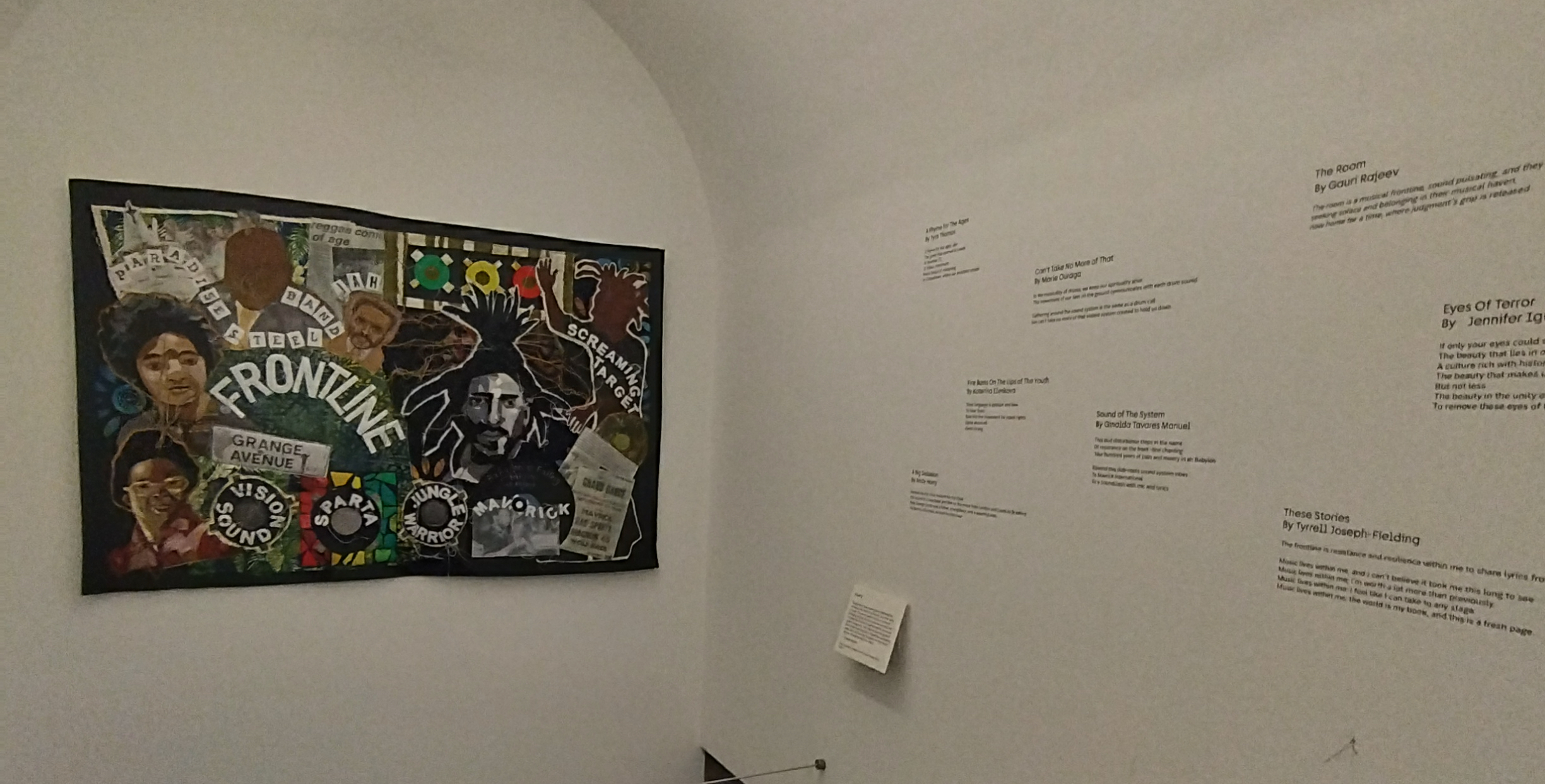
‘The Frontlines’ (1950s-1980s) primarily looked at community movements and the music coming out of Black British communities in places other than London, such as Bristol, Manchester and Glasgow. I appreciated the subsection on ‘Education and Protest’ here and especially enjoyed the textile piece and collection of poetry made by young people in Leeds exploring the legacy of protest within the local Caribbean community. A large part of this section was dedicated to carnival, including a breathtaking peacock costume, posters, photos, film, sounds and souvenirs from UK carnivals throughout the years since the very first one in 1959. I also enjoyed the mosaics exploring the key principles of Rastafari culture, accompanied by a moving soundscape inspired by ancestral drums and collective strength.
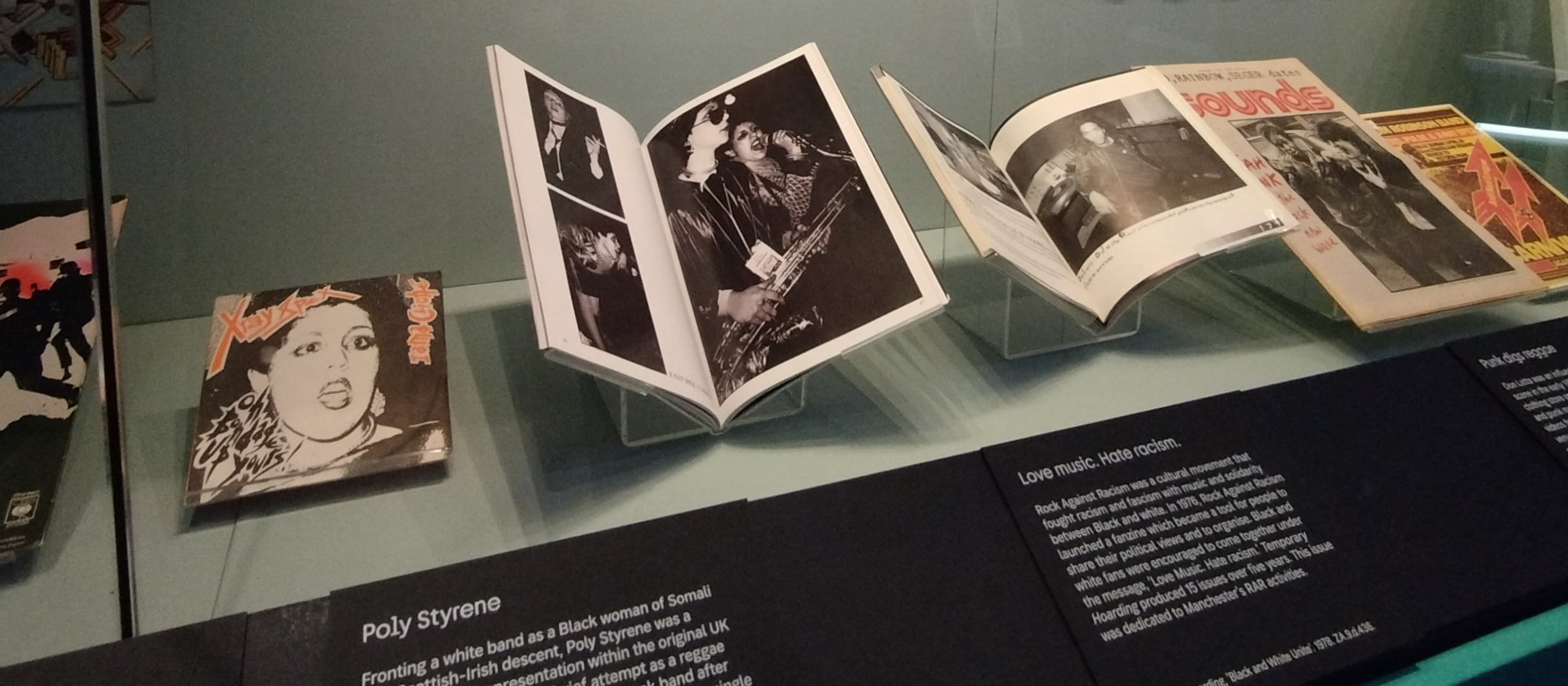
I heard the next section before I saw it. In ‘The Record Shop’ (1960s-1990s) there were several central dividing sections, four times my height, displaying dozens of classic Black British records in different genre groups, such as Roots Reggae, Lovers Rock and Two Tone, as well as more records, posters, magazine articles, film snippets, headphone points for listening and other record shop relics and paraphernalia displayed around the edges of the room. In one corner was the source of the sounds I heard from afar – two short films, one called ‘Self-made’, and the other ‘Done In Spite of You [DIY]’, which both explore the DIY spirit that informs and underpins Black British music and the unique sounds, styles and technologies it has created. Alongside these films stood a large hand-built sound system made by audio builder Friendly Pressure. I really enjoyed these films and could have watched them several times. A line from ‘Self-made’ stayed with me: “The music goes where we can’t”. I have felt and lived this truth, particularly growing up in an isolated, and very white, location in the 90s as the child of a Black singer-songwriter, as well as being involved with musical projects myself – and Beyond The Bassline affirmed how the connecting and liberating powers of music and sound are a huge part of the Black British experience.
The last section of the exhibition, ‘Cyberspace’, covered the time period from the 1990s to the present day. The intro text ended with, “Who knows what’s next? We are Black and British and power is in our hands” and was followed immediately by three of Simon Wheatley’s visceral photographs capturing intimate scenes from London’s early 2000s youth-led underground music scene. It felt exciting. This final section continued many themes present throughout the whole exhibition, such as protest, innovation, unapologetic style and the powers of community. It also highlighted the relationship between technological advancements and music making and the new sounds that came from this – including a nod to the beats aspiring creatives made from PlayStation samples and the music production skills Jme picked up by programming ringtones on a Nokia 3310. Subsections on genres such as Grime and Jungle, with lots of headphone and video opportunities, made me feel nostalgic for the days of rummaging through Woolworths bargain bins for 99p tape singles.
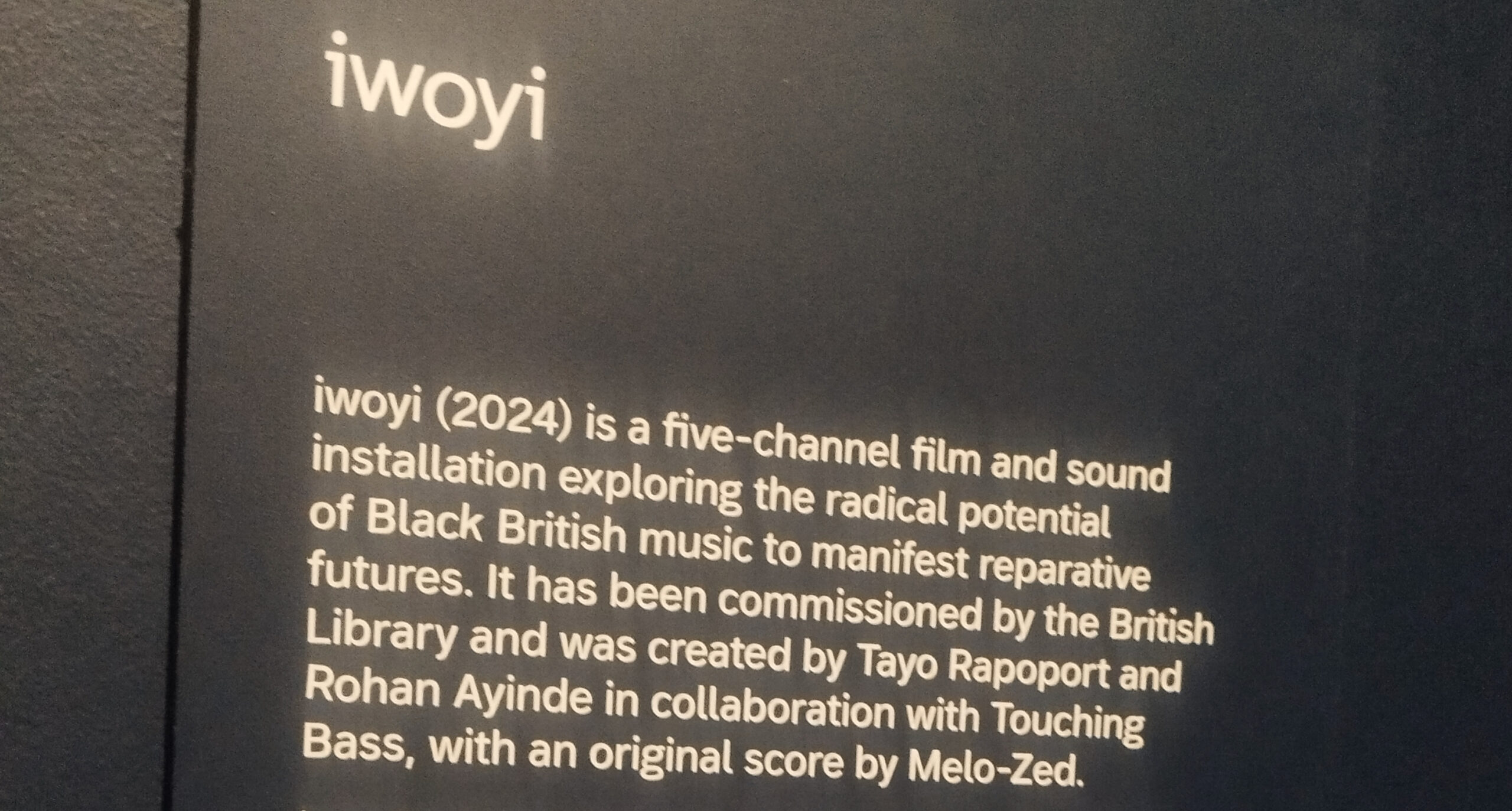
Perhaps my favourite part of the whole exhibition was at the very end: “Iwoyi: within the echo”.
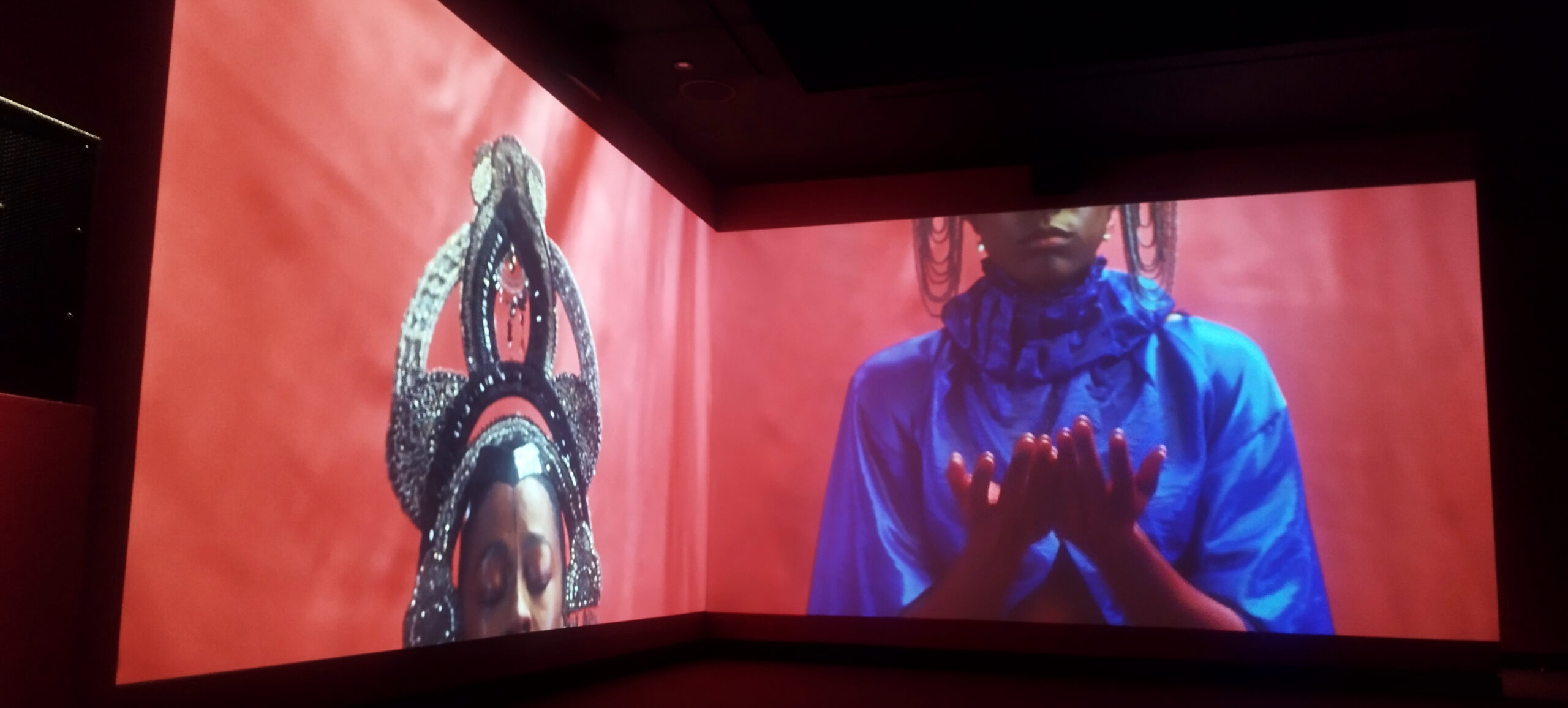
After experiencing iwoyi a few times, I dragged myself away in a daze and wrote in my phone notes, alongside a drooling emoji, including “I lay down and fell into a beautiful Black fiery wall of jazz and waterfalls’, to give you an idea of how much I was into it! But it was so much more than that, with deeply moving and inspiring poetry by Rohan Ayinde, breathtaking imagery of nature and space, dancing and dominoes seemingly from the past and future all at once, laughter and movement, wisdom and hope. Just as a line of Ayinde’s poetry expressed, iwoyi did an incredible job of “shattering any idea that there’s a beginning, or end, to a story that is still being told”.
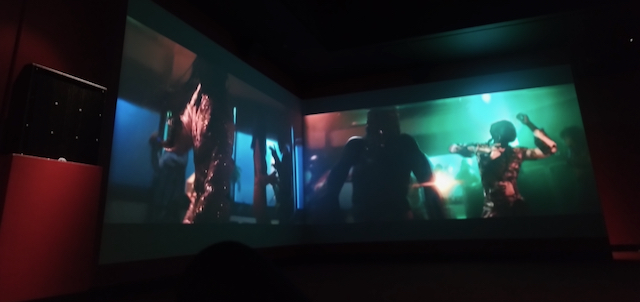
When writing this blog, I was over the moon to find the iwoyi film viewable online here – and slightly amused because on rewatching, I realised it doesn’t even contain any waterfall footage! There are mountaintops and rivers, but no waterfall. I guess something about the installation felt like a waterfall to me. In the exhibition, the film was shown in a dark viewing space on five large screens, one that was on the ceiling. It was surreal, multi-sensory and all-encompassing; and having the option to view from cushions on the floor made it all the more so. I’ve watched it online probably a dozen times now, and each time I notice something else and feel inspired to creatively “accentuate the cracks” in white supremacy, “so that something else can emerge”.
In discussing Beyond The Bassline with other people who visited, some have mentioned things – genres, artists, moments in history – they felt were missing from the exhibition. I feel like the achievements, creations and influence of Black British music are so far-reaching and ongoing that any exhibition on the subject could fill any space it was given – and there’s only so much that people can take in in one go. Dr Mykaell Riley, the consultant curator from the Black Music Research Unit, University of Westminster, explained in his personal prelude: “The exhibition is crafted to provoke inquiry and provide new insights into the narrative of ‘intimacy’ in Black British music and its power to challenge and redefine the mainstream British cultural, musical and political landscapes”. Similarly, Dr Aleema Gray wrote on ‘X’ about the exhibition: “In the spirit of bunning Babylon we are not providing all the answers – only a new set of questions that reflect on African and Caribbean musical heritage in Britain.”
I certainly left the exhibition feeling inspired and with more questions and curiosities to explore. I give thanks and look forward to seeing what emerges.
ABOUT THE AUTHOR | Jose Hall (they/she) is a writer and creative, mainly working with words in various forms – including poetry, stories, articles and songs. Jose tends to explore themes such as identity, nature, journeying, healing and experiences of being ‘other’, and has been published in a few places such as Black Ballad, The Black Explorer Magazine, Psychology Now and The Great Outdoors Magazine, as well as anthologies such as Hidden Sussex by Writing Our Legacy. With a background in art, music and film, Jose enjoys collaborating with other creatives and often involves music and sound in live poetry performances. You can find links to work & socials at journeyingjose.com.
***
Sharing your news Are you a member with a recent creative achievement that you want the world to see? Writing Our Legacy has thousands of followers across multiple platforms, and we want to help get your work in front of them. Whether it’s a published piece of work, upcoming performance or a residency, we would love to share your news with the world. Just fill in this WOL members news submission form any time.