
Artist, writer and performer Alinah Azadeh developed the We Hear You Now project, a series of listening posts on the South Downs that give space to those voices often missing from the Sussex countryside. Having sat quietly in the landscape for over a year, the posts were targeted in coordinated acts of racist vandalism in August 2024. Nine months on, she reflects on the experience.
“Imagine all those who have ever been here before you, over the millennia; our ancestors from the Middle East, Africa and across Europe, travelling over the land bridge to this island before it split apart from the mainland, escaping environmental disaster, war or persecution. Imagine us all with our tap roots, reaching down into the depths of the estuary channel, connecting with the families of hawthorn, amidst the moist genius of the mycelium networks. Imagine us all becoming more than human in the chalk, the soil and the mix of spring, river and seawater below…”
From the winter of 2019 into the spring of 2020, I had an Arts Council research and development grant to develop a pilot project researching, walking and writing the chalk coast of Sussex, with which I have a personal connection. During this time, I wrote a short piece of speculative fiction, magic realism, which became the prologue story, We Hear You Now, set along the chalk cliffs of the Seven Sisters between Birling Gap and Haven Brow.
I wrote it in response to the continual chalk drops I witnessed reshaping the line of the cliffs through warming from climate change and the parallel borders going up after Brexit – and out of my shock at the subsequent ramping up of the toxic anti-immigrant rhetoric and normalisation of the hostile environment policies.
Now on a listening post on Haven Brow cliff above Cuckmere Haven, the story centres around an encounter in 2053 between a girl of migrant heritage and the cliff as a character itself, inviting and provoking the reader or listener to reflect on their own relationship to land, belonging, climate, migration and our shared futures.
Integral to the story are the many voices of ancestors in many languages who have arrived and settled here over millennia, rising up from the grassland as the girl lays her ear to the ground. She hears also a single voice asking for her to offer own story back to the land and invite others to do the same, to help regenerate the land itself.
This piece became a blueprint for the future project, We Hear You Now. Originally conceived as an installation or large-scale on-site performance, the project was delayed by the Covid-19 pandemic and morphed over time. During this period, I developed an ongoing dialogue with the South Downs National Park Authority (SDNPA), became the first Writer In Residence at Seven Sisters Country Park (SSCP) and along the Sussex Heritage coast, obtained two further Arts Council grants and continued thinking with Writing Our Legacy about the voices that were missing in this Sussex landscape, having been one of the writers published in their anthology Hidden Sussex.
Decolonising the landscape
As I read Corinne Fowler’s Green Unpleasant Land: Creative Responses to Rural England’s Colonial Connections, Anita Sethi’s We Belong Here, Octavia Butler’s Parable series and Adrienne Maree Brown’s Emergent Strategy, and as I also walked and talked with national park and National Trust rangers, climate change specialists, local residents and lovers of the coastline, I began to understand that decolonising a landscape – or creating equity of voice and presence – is a collective endeavour that happens slowly over time, in community. I realised that my solo residency needed to be re-imagined.
I wanted to not only make space for my own work as resident writer but also amplify other creative voices missing from this pastoral landscape: older women’s voices, Black voices and other voices of colour, migrant voices, queer and non-binary voices, working class voices, disabled voices. And also to centre the most crucial voice of all: the voice of the land and its challenge to us to reciprocate the care, protection, spaces for rest and joy it has always given us. My intention was that our voices would somehow be embedded in the land and could act as a welcome, a creative spark – and a marker of radical hope in these precarious times.
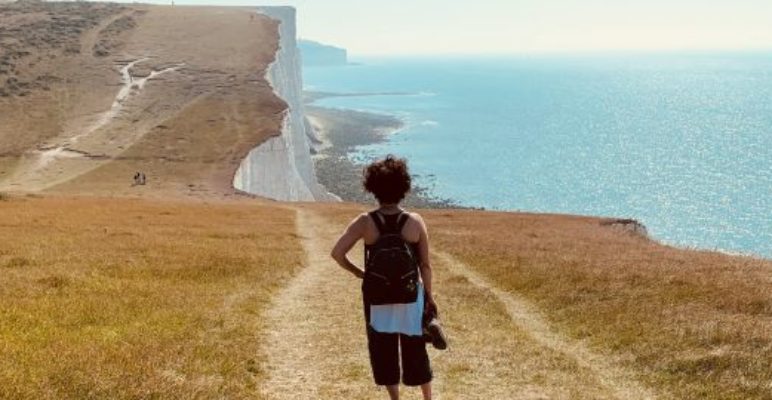
Alinah Azadeh on the South Downs. Image credit: Lilliana Gibbs.
What followed was a two-year walk and write programme, We See You Now – a series of outdoor retreats, workshops and writers’ groups for Black and global heritage writers co-produced by Amy Z. Glass of Writing Our Legacy in partnership with SDNPA. This was a programme not just of creative engagement and nature connection, but of the human heart, as we fostered kinship, intimacy and solidarity, holding spaces for writers to explore the everyday experiences of racism (the murder of George Floyd fell within the first year), sexism, ecological anxiety, health issues or mental fragility, exacerbated by pandemic life around us. It was also full of joy, rest and restoration.
Around 45 writers were involved in the programme, and, in 2023, we commissioned 10 of them to create work that would be featured on a series of physical listening posts in the South Downs for five years: a simple, achievable way to embed audio stories into the land that I was so inspired by. The We Hear You Now audio trail launched across the landscape in June 2023, and was framed by six months of public programmes and activity, including events at Brighton Festival, Charleston and Walk the Chalk, and a collaboration with Writers Mosaic. Writers whose poetry and story feature on the trail are Razia Aziz, Dulani Kulansinghe, Akila Richards, Jenny Arach, Joyoti Grech Cato, Oluwafemi Hughes, Pauline Rutter, Sheila Auguste, Georgina Parke and Georgina Aboud – all Writing Our Legacy network members.
This audio walk sat rather quietly in the landscape after the buzz and hum of the public programme, and my residency ended in November 2023.
The race riots and the targeting of our listening posts
Until, that is, in late August last year, when it was racially targeted by an individual or group and all 14 posts across six kilometres of land were removed, screw by screw, and racist graffiti was scrawled near the Seven Sisters visitor centre. These acts followed on from the summer’s racist riots and felt like an extension of them in the form of calculated cultural violence upon our work. I was surprised that there had been no backlash earlier: it took racist riots to embolden the people who did this. The impact on us as a group was sharp and deep, as was intended. It was a powerful emotional shock. Understandably, some writers could not engage at all due to upset but most were keen to regroup and find a collective response rather than an immediate reaction.
That fact that staff on the ground initially did not grasp, or could not believe, that what had happened was racially motivated – despite my naming it immediately – led to some upset among us. But there came a very quick course corrected response from the SDNPA communications team as we confirmed that the whole trail was missing and asked them to listen to us and our lived experience, knowledge and expertise in facing this kind of event.
We as writers, with the support of producer Laura Edmans, were asked to formulate a written response addressing the next steps we thought should be taken. This meant many hours of work listening, fielding, compiling responses, comforting each other and discussing strategies: an intense emotional load that took a toll on our physical and mental health, and on our families.
We came back with 6,000 words written to help SDNPA staff to hear, absorb and understand the impact on us, defend the dignity of our work and not shy away from naming it as racial harm. It began: “It is distressing to witness this racist attack on our voices and words. It’s sometimes difficult to know where to put the feelings.”
The SDNPA’s response was to put out a clearly worded statement, file a police report and start taking steps to replace the work immediately. The statement included the assertion: “As no other plaques were targeted in the area, we can sadly only assume that the theft is targeted and racially-motivated, and has been reported as such to Sussex Police.”
They were sensitive in their dealings with us, and thoughtful. They did not pressure us to react quickly or get involved directly. Events at Seven Sisters Country Park were cancelled for a week in case there was any other backlash on site.
Continuing our creative resistance
In response to us amplifying this across the cultural sector, solidarity walks were organised, the Towner Eastbourne published our work on their Soundcloud indefinitely, and many other organisations offered to amplify our work and stand in solidarity with us publicly.
After the attack, we were so exhausted that it was hard to respond fully or even to join the public solidarity walks that were organised by local antiracist and other groups. I felt burned out and depleted.
Since last August, we have felt the ripple effects, learning and solidarity both regionally and nationally, including most recently at a panel event called ‘Amplifying Voices in Protected Landscapes’ alongside Corinne Fowler, whose initial book and literary activism in community inspired us to start making connections between colonial history, and the power of literature to reshape narratives of belonging to land. Whoever sought to erase us from the landscape by stealing our work will have seen the opposite effect in the way that the project has been amplified and policies around rapid responses to racist cultural attacks and spaces for clearer reflection on systemic issues are now emerging.
The best way for the Writing Our Legacy (WOL) and wider community to support us is to listen to and share our work – and to have the courage to write and share your own. WOL was instrumental in laying the ground for me to dream up where the story of the girl on the cliff might take us. Long may we all continue the journey of creative resistance together in these intensely challenging times.
This piece has been adapted from a talk given by Alinah Azadeh, ‘Do You Hear Us Now? Reimagining the relationship between artists and institutions’, at An Exploration of Cultural Sector Responses to Racism in Public Spaces, held on 3 March 2025 at the University of Sussex and hosted by Culture East Sussex and the University of Sussex. The opening extract is from Taking Root, a piece by Alinah for We Hear You Now.
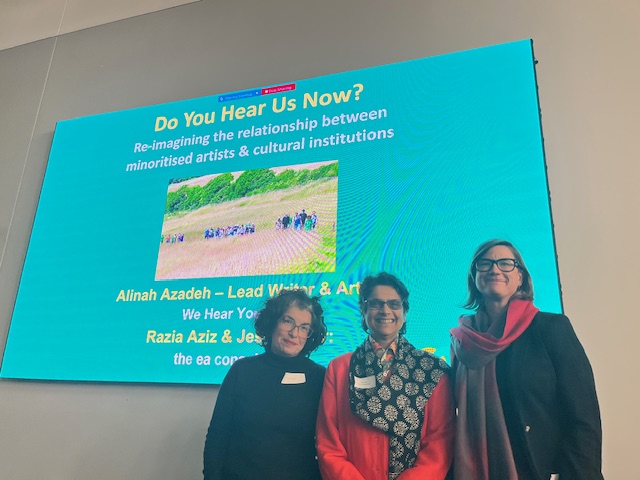
From left: Alinah Azadeh, Razia Aziz and Jess Taylor at the University of Sussex, March 2025. Image credit: Laura Smith.
***
Find out more about the We Hear You Now project, in place until 2029, including a guide for walkers, audio playlist and background research on the work recorded. Listen to the We Hear You Now stories on Towner Eastbourne’s Soundcloud
Listen to Alinah’s podcast, The Colour of Chalk
Read about Alinah’s most recently launched work in the landscape, The Four Directions here
Read and follow Alinah’s work on her Substack