
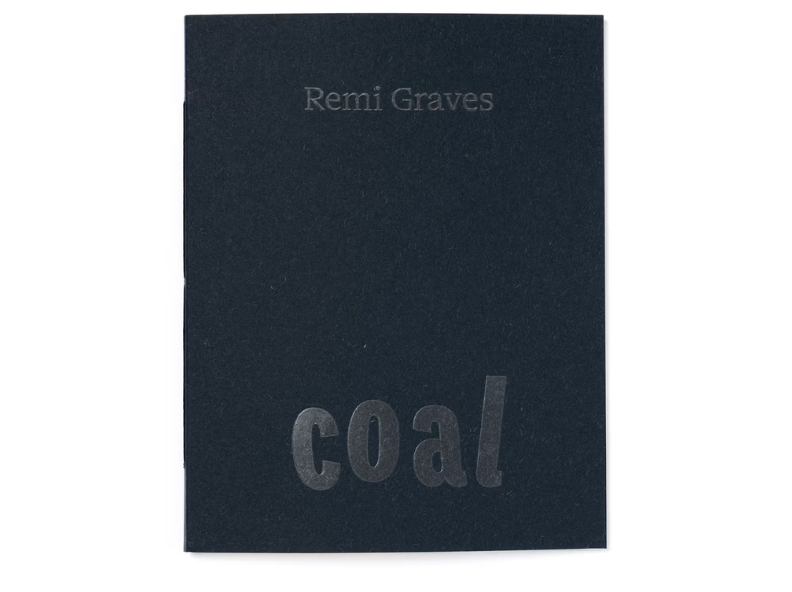
Writer Jessica Olivia Neill explores the latest poetry collection from Remi Graves, coal, published by Monitor Books in 2025. Jess’s review is a Writing Our Legacy Creative Commission.
They say you can’t judge a book by its cover, and while that may be true, the first thing to say about Remi Graves’ coal is that its cover does hint at its contents.
Textured, different colours in different lights, subtle, nuanced, inviting – all descriptors one could easily apply to the work it binds together, which tells/imagines the story of Paul Downing, a Black transmasculine Cherokee person committed in 1905 to the City of London Asylum.
In their ‘poems and experiments,’ Graves attempts to give voice to the silence in the archives they visited for the best part of 10 years, an act of sincere compassion that restores the humanity Downing was stripped of when admitted to an institution that failed to truly see him.
Incorporating visual fragments in the words, sketches and snippets of photos, the work seems to act like an archive itself, with all its fractures, repetitions, incompleteness and fixations. Take ‘Pitch’ for example, a piece to the left of the centrefold, facing an image on the opposite page – a silhouette, a shadow, of, presumably, the author cast onto a brick wall, adjacent to the line, ‘when two times touch’:
‘I follow my train of thought through a field of homophones. It picks me up at the word weight, crosses the border into French and leads me to poids, then pois, which ignites my appetite for un petit moment. Finally I get off at poix, which I thought meant smallpox but actually means pitch. Not like, oh let me pitch a tent amongst these two languages, or these two genders (gender being a kind of language). Nor like substance used for repairing ships, polishing mirrors, for fuel and torches. Which gets me thinking about pitch black, an illuminating tautology that carries both question and answer in its doubleness… Three and a quarter hundred years later, our Paul is found on Blackfriars Bridge, described by a journalist as coal-black. The past and the present are synonyms: look different, sound different, same old shit.’
In this Derridian (I think, in truth I am not an academic) prose poem, Graves moves from one association to another, following their ‘train of thought’ from their now to Downing’s then. Making a bridge between a time Graves cannot know and yet also understands because the present is synonymous with the past. The image and its caption underscore this collapsing of time: ‘when two times touch.’
Graves connects with Downing not only in their imagination but also in the London streets that Downing also wandered. In the casting of Graves’ shadow on a wall that Downing also passed (is my presumption), they cast a message in a bottle to the past. Making, in all their care and attention, their want and need to reach out through space and time, the imperative assertion that Downing was a person who deserved, like all people, to be seen, cared for and loved. Who had a body that cast its own unique and unmistakable shadow.
coal is an ambitious and highly successful attempt to render the sterility of archive into something fertile and alive, perhaps because in their loving explorations, the poet is, in fact, in part at least, in search of themselves.
‘These poems and experiments, then,’ Graves says in their opening field note, ‘can only ever be a record of my search for parts of myself in the archive. A trace of all that cannot be found there and a portal for all that can be felt, despite everything I know.’
Portal is a good word for it – you are indeed transported. To another time, to another person’s mind and perhaps to parts of yourself you might not have known existed.
At the end of the book, you see the photo of Downing that inspired Graves to find out who he was and to render him through the poems in this collection. Looking straight into the camera with a look of quiet assertion, it’s easy to understand why Graves was quite so taken with Downing, whose face seems to say: Am I not a man? Over a century later, when trans rights are increasingly threatened, it’s a powerful image and question to sit with – one our institutions have yet to truly answer.
coal by Remi Graves was published by Monitor Books in 2025.
Buy a copy from the WOL online bookstore for £14 plus £3 UK postage.
About the writer
 Jessica Olivia Neill is a Bristol-based writer, producer and accredited funeral celebrant. Born and raised till aged nine in Jamaica, her work is often concerned with themes of memory, history and belonging, strongly underpinned by a reverence for nature. She’s written, produced and directed two independent, crowd-funded films, one in honour of the memory of her father, the late Jamaican magician, Bunny Neill, and another about returning with her brother to their childhood home in Jamaica. She’s currently working on an archive research project about an 18th century shipwreck, using the funeral as a conceit to curate original artwork and performance by artists of the Caribbean diaspora.
Instagram: @jessolivianeill