This autumn, writer Dr Tulika Jha joined a Writing Our Legacy network gathering trip to see Period Parrrty, a debut play by Gayathiri Kamalakanthan at Soho Theatre, London. Tulika’s review is a Writing Our Legacy Creative Commission.
At Soho Theatre, Period Parrrty unfolds like a memory: intimate, layered and pulsing with the contradictions of love and identity. Written and performed with aching honesty, it is a play that explores intergenerational trauma and healing. Diasporic belonging is portrayed through the coming-of-age of Krish, a young Tamil person discovering their non-binary identity within the rituals of family and culture, both at home and outside, but most importantly within themselves.
The titular ‘period party’, a celebration marking Krish’s first menstruation, forms the play’s emotional core. What should be a joyous rite of passage (and this is clearly maintained throughout) instead becomes a ceremony of estrangement, a performance of womanhood that Krish cannot inhabit. The event is staged like a miniature wedding, complete with veils, music and ritualised gestures, signalling the life laid out for Tamil daughters: one of obedience, marriage and motherhood. Beneath the laughter and family warmth, the sense of suffocation is palpable. What struck me was the flashbacks of my own wedding ceremony in India, and even though the heterosexual marriage was my choice, the rituals and performance were not. What I most appreciated was that it is this CHOICE that the play tries to uphold, and not that indigenous traditions are constricting in themselves, which would become a reproduction of coloniality. ‘To love is a choice, and I am happy with who I am,’ Krish later asserts as a reclamation of their whole self to their mother in a mixture of English and Tamil.
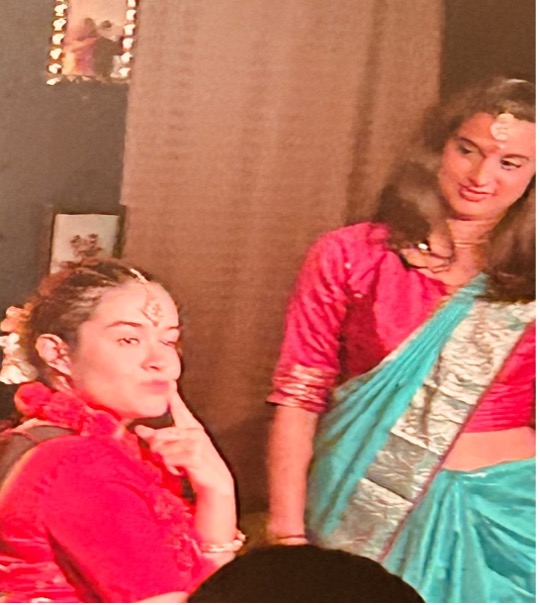
Photo © Dr Tulika Jha
Krish’s best friend Bee, also Tamil, brings levity and heart. Together, they embody the duality of diasporic youth, mocking the traditions that constrain them while still finding comfort in their rhythm. Their friendship is full of tenderness, rebellion and love. It is a relationship that gives the play its grounding, reminding us that solidarity, especially between queer and diasporic friends, is often a lifeline. For diasporic young people, who don’t fully inhabit their parents’ cultures, nor the culture of the host land, these friendships enable them to belong in a third space, one of their own creation and subversion. I was thrown back into my memories of my dear friend, who made this possible for me when growing up in the British Steel Garden town of Scunthorpe. When we had each other, we didn’t knock on doors for belonging.
The tension between Krish and their mother sits at the heart of Period Parrrty. When Krish admits, ‘In any language my mum won’t understand that I am non-binary,’ the line lands with quiet devastation. Their mother’s love is fierce but filtered through the lens of survival and sacrifice. She fled Sri Lanka during the Tamil persecution, pregnant and terrified, telling immigration officers that if she was sent back, she would end her life and her child’s.
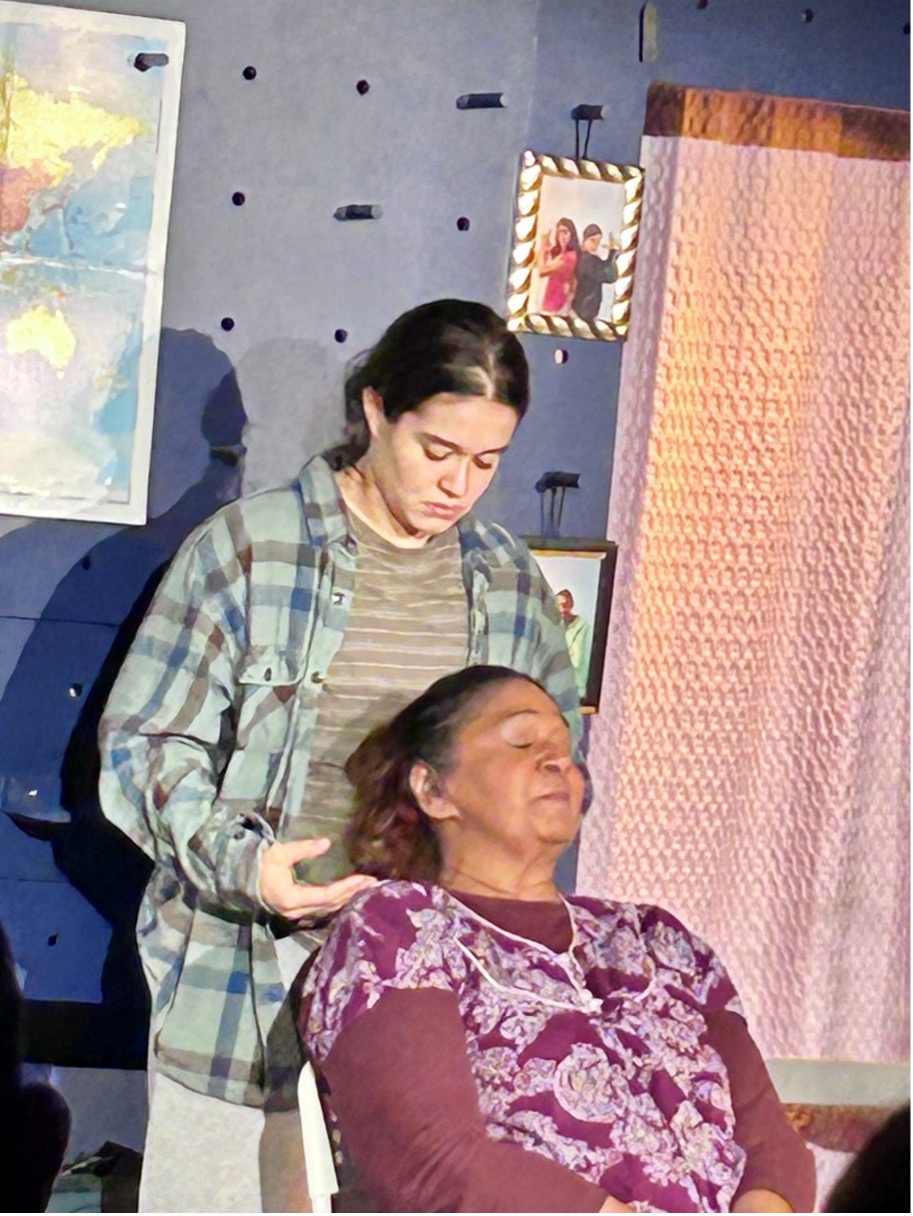
Photo © Dr Tulika Jha
Later, she tells Krish, ‘We did it all for you, but you don’t like us.’ It is a line that freezes the air; in the theatre, the silence was so complete, I could hear the soft click of the air conditioner. The burden of the sacrifices our parents made for us, then put upon us, can become difficult to tolerate. When gratitude is measured by the extent of conformity and obedience, it makes one wonder why the sacrifices were made if not to grant the next generation the freedom the parents never had. There is a malignant attachment to tradition and community at the cost of freedom. It made me wonder whether that generation has seen so much loss that they cling to the shreds of community, even if it constricts them and their children. Krish says to their mother, ‘You care more about what other people think than my happiness.’
One of the most affecting scenes comes when Krish suffers a panic attack beneath the ceremonial veil during a photo session at the period party. It is a moment of visual and emotional claustrophobia that captures the crushing weight of expectation. It echoed my own memories of rituals that honour us while binding us to roles we never chose.
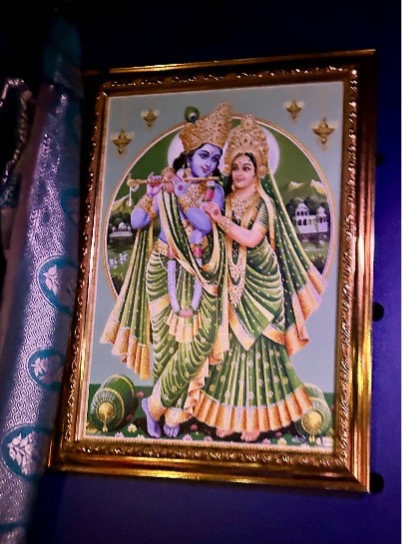
Photo © Dr Tulika Jha
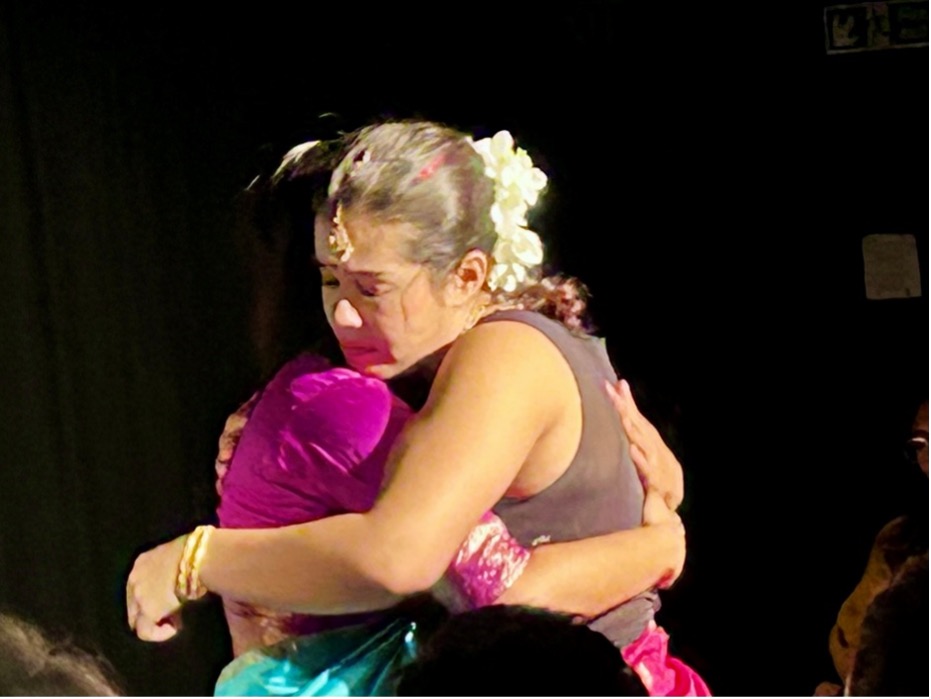
Yet, amidst the pain, Period Parrrty finds grace. Over a tender hair-oiling ritual, Krish and their mother share stories, secrets and fleeting understanding. And when Krish finally reaches for their mother, speaking in both Tamil and English to explain their queerness, the courage on both their parts is full of vulnerability and awe. The culmination of this exchange in an embrace feels fragile but profoundly human. It is a moment not of resolution, but of recognition that love transcends all transgressions that are imposed upon us.
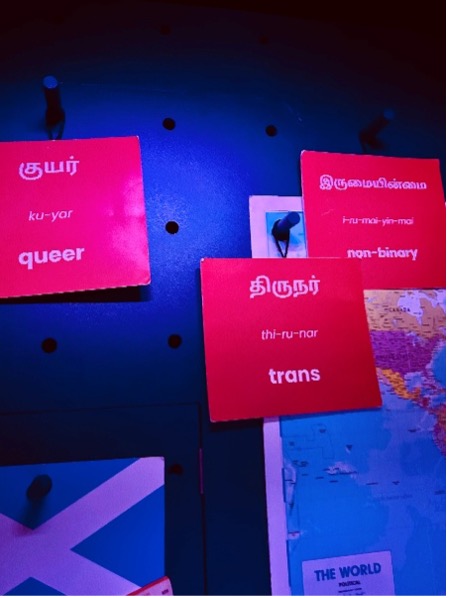
Photo © Dr Tulika Jha
By the play’s end, Krish’s journey becomes one of reclamation. They return to their heritage with new eyes, finding queerness not as something foreign to Tamil identity but embedded within it. In language, mythology and gods like Krishna, whose name they share. This rediscovery of belonging beyond binaries, beyond colonial and patriarchal definitions, feels both radical and deeply rooted.
Period Parrrty is a remarkable exploration of what it means to belong to a family, a culture and oneself. It is a play about mothers and daughters, faith and flight, language and silence. It asks what we owe our ancestors and what we must shed to become whole. It also asks what the Empire has snatched from our ancestors: land, knowledge, language and connection.
Heartfelt, humorous and unflinchingly honest, Period Parrrty is not just a story of coming-of-age. It is a story of coming home on one’s own terms.
About the writer

Dr Tulika Jha is an intersectional Crip Brown Feminist. As a mental health doctor, she believes in combining social justice principles to disrupt and build care that is reciprocal and collective, beyond expert and patient boundaries.
One of the epistemologies she considers crucial is that of creativity. She has written poetry and prose and facilitated workshops for Healing Justice London, Synergie Collaborative, Consilience Journal, Stolen Tools magazine, Civic Square, Mad hearts (QMW university) C4CHEd (Care professionals for compassionate Health Education), Home-TORCH Project and BMJ British Medical Journal: Putting the ‘being’ into well-being.
Main photo credit: © Dr Tulika Jha