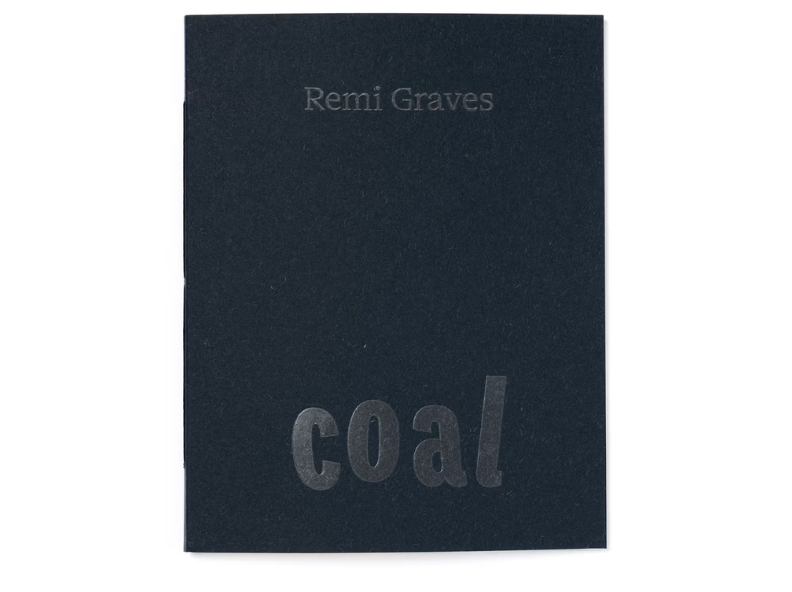
Writer Chris Odogwu explores the latest poetry collection from Remi Graves, coal, published by Monitor Books in 2025. Chris’s review is a Writing Our Legacy Creative Commission.
coal, a poetry collection by Remi Graves, reimagines the life of Paul Downing, a Black transmasculine person arrested by the London police in September 1905, through archival materials and poetic creativity.
Race and gender are common themes in Graves’s earlier works. Published in 2025, coal expands this focus by exploring how systemic biases and prejudices related to race and gender lead to marginalisation and discrimination. The collection reflects a consistent artistic practice and a strong commitment to examining the intersection of social and individual identities.
The field note at the start instantly engages the reader with Paul Downing’s story. Its measured opening sentences make it feel more like a thriller than a typical introduction. Graves introduces Paul by building suspense and curiosity, noting the sparse surviving documentation of his life. This approach highlights the collection’s main goal: reconstructing a life not fully represented in history.
The meaning and impact of the title
The title coal carries deep symbolic meaning in this context. After Paul’s arrest, a journalist described him as ‘coal-black.’ He was labelled through a racial lens, minimising his humanity.
It also serves as a reminder of London’s early 20th-century industrial landscape, highlighting a tough urban setting, a time when minority groups were deeply marginalised.
The title signifies linguistic reclamation. Graves deliberately transforms a term deemed derogatory into a symbol of resilience.
Overview and themes
Gender and race play significant roles in the collection, especially in shaping and documenting Paul Downing’s identity in official archives. It reveals how racial language reduces him to labels like ‘coal black,’ while strict gender expectations leave him outside accepted social groups.
The archive is presented as a sacred space for stories to survive. Shifting between past and present, coal weaves together events from centuries ago and today, highlighting common social constructs. Documented stories from the past become the ‘truth’ of those times in the present.
Visibility and perception are also examined. The past often seems blurred or obscured, requiring careful examination to uncover truths within archival fragments. Graves highlights both the visible and the concealed, emphasising the tension between documentation and lived experience.
Language, style, and form
Graves’ use of clear, deliberate language choice builds emotional impact, while experimental structure shows the subjects’ feelings of urgency. In ‘A Knife, a Bible, a Comb,’ the lack of punctuation creates a breathless, stream-of-consciousness effect, illustrating Paul’s panic and fatigue.
‘Tightrope’ uses repetition by starting each sentence with ‘let’s,’ fostering a collective voice that reflects societal judgment. This technique highlights prejudice as a common social behaviour rather than isolated incidents, deepening the reader’s grasp of systemic oppression.
Graves emphasises the influence of language as a key cultural force. In ‘Pitch,’ they explore the word’s historical evolution from its earliest use by John Marston in 1598 to its later associations with racial descriptions of Blackness. Lines such as ‘Oh let me pitch a tent amongst these two languages’ engage with the dual meanings of ‘pitch’ in English and in French as poix, offering a moment of levity while highlighting complex social and linguistic histories.
Religion and spiritual symbolism
Religious imagery shapes the collection’s moral framework, predominantly reflecting Christian themes. Terms like ‘canonisation’ and ‘miracles’ are in the poem ‘How to Become a Saint’. Other titles, like ‘Miracle’ and ‘After Visiting the Cemetery,’ which references a verse from the Gospel of Matthew, have religious undertones.
Christian symbolism is also prominent in ‘A Dying and Rising God,’ which reinterprets the biblical story of Eutychus and Paul the Apostle.
Paul undergoes a ‘first death’ when society diminishes his dignity, and the poem portrays resurrection as an act of personal resilience rather than divine intervention. The line ‘Trouble not yourselves for his life is in him’ criticises institutions that offer words without real protection, and the structured stanzas reflect a gradual reclaiming of identity.
By presenting Paul Downing’s experience within this framework, Graves implies that recovering marginalised histories is a form of resurrection, highlighting their view of archival work as a moral and spiritual pursuit.
Strengths and weaknesses
coal’s strength lies in its layered storytelling, combining historical research, lyrical imagery, and experimental structure to piece together Paul’s life from scattered records.
The collection covers an important topic and adds to current debates about transgender identity and rights. It also challenges the idea that trans identities are new by showing Paul Downing’s story as part of a larger history. This shows that these discussions come from real human experiences shaped by visibility, exclusion and resilience.
Intersecting with other poems grounds the book rather than leaving it isolated. Graves’ artistic dialogue with other poets places their work within a broader literary tradition and emphasises creative inheritance and change.
Drawing on historical and religious contexts enriches the book by grounding its themes in familiar stories. This approach helps the poet link past and present. It also transforms archival recovery into a form of resurrection, adding emotional and philosophical depth to the poems.
Although the collection’s engagement with religious stories and other poems adds depth, it can also make it harder to access. Readers unfamiliar with these references might struggle to understand their context and deeper meanings.
Since Christian imagery and symbols recur in the book, they might make it less appealing to readers who are not religious or follow other faiths.
Conclusion
By reimagining Paul’s life so powerfully, coal captures the essence of staying true to oneself amid difficulty. It brings Paul’s heroic narrative into historical memory, a recognition he rightly earned.
coal by Remi Graves was published by Monitor Books in 2025.
Buy a copy from the WOL online bookstore for £14 plus £3 UK postage.
About the writer
 Chris Odogwu is a writer exploring identity, culture, and social issues. He’s a contributing author to the anthology Suffolk Haunts: Original Stories Inspired by the Legends and Landscapes of East Anglia. A member of the Society of Authors UK, Chris holds an MA in Creative and Critical Writing from the University of Suffolk. His work has been published in leading publications, including UN Today.