
Seema Kapila
Excerpt from "FIVE PART HARMONY"
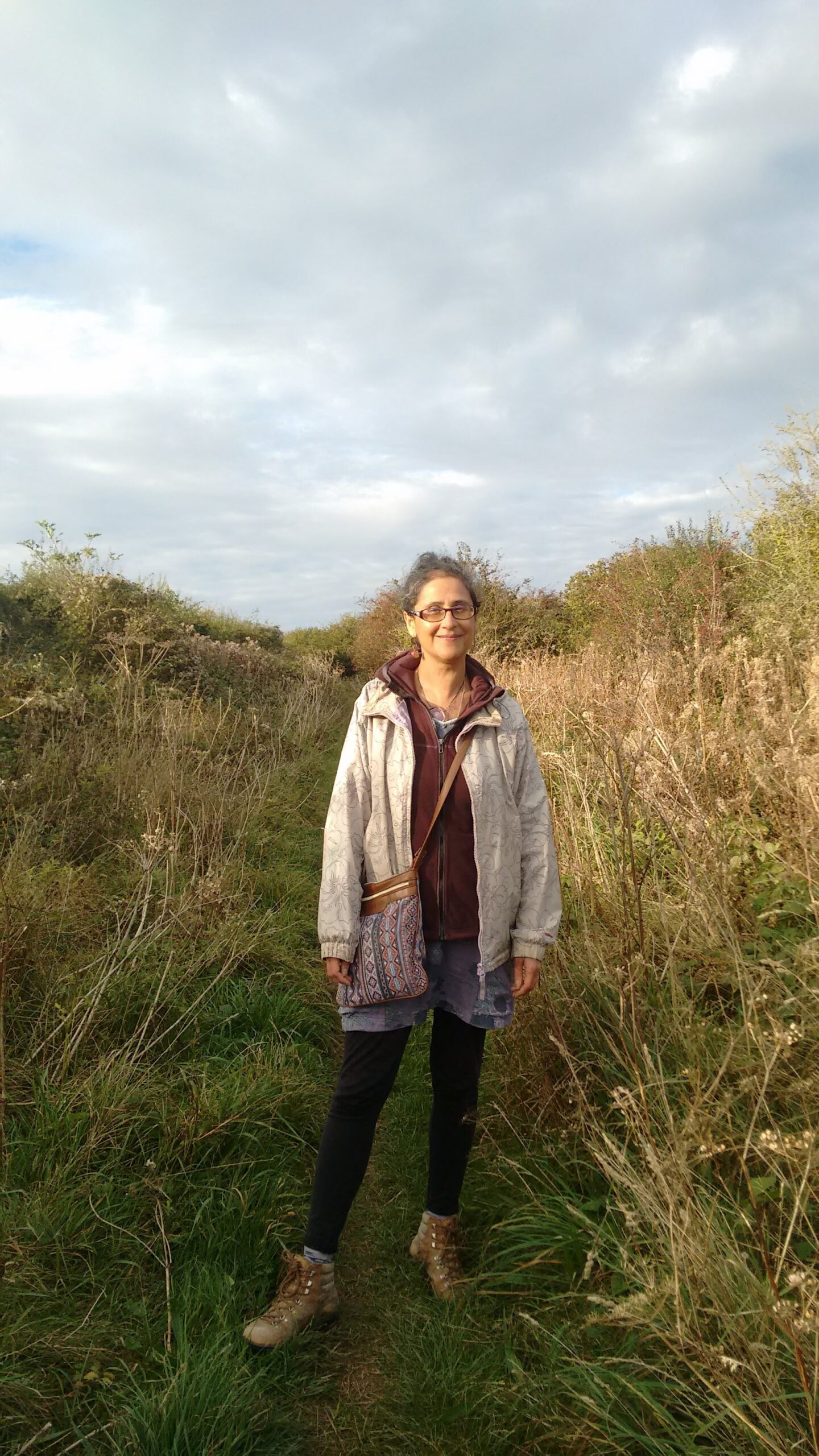
Seema Kapila is of Indian heritage, born in Kenya, moving to London in the 1970s. Having made a dedicated career in supporting voluntary and community groups, she now juggles family and care support responsibilities with her passion as a singer songwriter, short story writer and poet. She fronts an eclectic indie band ‘The Seema Tree’, a crossover blend of folk, blues, pop and rock. Her published work includes: ‘Shimla in the South East’ a short story in True Tales from the Old Hill (Frogmore Press, 2015); 'The Ripple’ a short story in Watermarks - Writing by lido lovers and wild swimmers (The Frogmore Press/Pells Pool, 2017); and ‘Night Pearl’ a poem in Pale Fire - New Writing on the Moon (Frogmore Press, 2019). Seema is a real advocate of 'open mics' where people can come and share their experiences creatively. Her song writing and literature weaves heart felt tales that explore universal human themes including joy, sorrow, mental health, and love. She writes about people she has met and places and communities in time. With an immense respect for the healing power of nature, she walks as often as she can; and currently resides in a creative corner of Sussex with her family and cat.
Instragram: @the.seema.tree
Facebook: https://www.facebook.com/The-Seema-Tree-279026255847082/
Seema was one of the Covert Talent Development participants for 2022-23. This piece was published in Covert Issue 3 -- buy the magazine in print for £10 or digital for £5 from our online shop.
Published in Covert Issue 3
FIVE PART HARMONY
PART ONE
The bell tent stood in the dining room, wrapped in its beige cover from when it had been dumped there at the end of the last camping trip. Over a year ago now and it was still there. There was no room for it to be put anywhere else. No designated place or spot where all the camping gear lived throughout the rest of the year. It was a forgotten marble pillar, propped up in the corner, misplaced in time and space. It reminded Rashmi, if she had any time to remember, of a quieter, more reflective ‘past’ life.
And so it was camping time again. In an attempt to accommodate this year’s camping, she frantically darted from pillar to post, trying to finish numerous tasks. Although the campsite was just outside her small town, she did not want to be comforted by the fact that it was close and hence could pop back at any time. To her, time away, for better or for worse, was time being fully away.
The untidy utility room at the back of the house stored some of the other camping gear. Her husband, being more streamlined in thought, had in fact piled some items into a few old cardboard boxes. Lanterns, water containers, crates for food and drink, pots, pans and utensils. A rather full kitchen cupboard housed another box of candles, matches, head torches, clothes pegs, medicines, and plasters. Further gear was rediscovered around the house.
With everything gathered, the front room was now piled high, waiting for the morning, when with a heightened air of tension and excitement the family would shift everything from inside the urban fabric of a Victorian house to the outside of a farmer’s field. With only the late summer grass, trees, and hills all around them.
PART TWO
A number of car trips brought the camping gear into the field. To reach it they took a dirt road that at times, on other camping trips, might have been waterlogged and therefore unpassable. On these occasions camping timings had to be rescheduled.
The campsite wasn’t really a campsite. It was more a cornered-off piece of a farmer’s field. The tenant farmer had no time to publicise and it was, therefore, very underused. The fact that it only offered a few fire pits, an outside toilet and a water tap in the neighbouring field meant that it was only the hardcore who attempted to camp here. That suited this family and their friends, who had camped together for a week every year for the last nineteen. Stripping down modern-day life back to its basics to help shine a light on what was really important.
Her duty once the main family bell tent was up was to sweep out last year’s now dried grass and dead insects so that the carry mats, sleeping bags, rugs, clothes, coats and shoes, toys and crafts could all be brought in and organised. How interesting she thought, in the house, everything was piled up. Function and place had lost their meaning. Here in the bell tent, everything had its place and function. It was minimalist. It was appropriate.
She came to the campsite with no makeup on. She thought it would be difficult to put on and clean off, and anyway what was the point. Nature’s mirror didn’t need to reflect extra baggage even if it was only her subtle eyeshadow and mascara. But she always chose loose flowing clothes that kept her covered and cool in the day and served as good base layers when it got cold at night. She liked colours, pretty colours, frocks and shawls that made her feel like a free-spirited woman caring for her home and land; natural in the right place and time.
She and her family often arrived late on the campsite, so by the time the main tent and separate ones for the children were up, it was getting dark.
There was usually enough firewood left by the farmer to start a fire. To her this was quite a ceremony; the lighting of the first fire, then days later, the dousing with water of the last, to protect the dry grass when they all finally left for another year.
Once the fire was lit it never really went out. It might reduce to small embers but it would soon be rekindled. A constant to return to. Occasionally someone would light an incense stick; its sweet fragrance entwining with the subtle smell of the tall grass, the earthiness of the dried soil, and the fire’s smokiness.
The first evening would come fast; offering perhaps a beautiful sunset or the sight of the familiar barn owl. Easy burgers and sausages in buns eaten. And then the first real chance to sit together around the fire.
A year had gone by and all these friends, parents, children, young adults had had different lives. A mismatched herd of human beings of differing races, ages and genders; vulnerabilities owned or undefined. On the campsite they were reunited and reconnected; reconnecting not just with each other but also, the land, the fire, and with themselves. It was a time for recharge. They could all start breathing out again.
PART THREE
Often, being the last to bed, having chosen to sit quietly in the cool night air, she would not be up early the next morning. She would lie in the bell tent; the canvas wall a second skin connecting her to the outside. The ripple of the breeze or patter of rain on the fabric rejuvenating her.
Eventually everyone would congregate around the fire for breakfast; chatting over hot drinks and food. Everything took time, from the children fetching water from the neighbouring field, to adults boiling water and cooking. Perhaps someone might brush their hair, perhaps someone might brush their teeth.
Over the next few days, and particularly if it was getting hot, she witnessed the communal slow exhale, everyone becoming slower-paced. Funny, she thought, when she was inside the house everything was fast: fast cooking on the electric cooker, fast boiling of water in the electric kettle, and tasks done fast so that she could be outside. But here, outside already, there was no destination to reach. This was contentment. She shut her eyes, letting the Sun warm her face.
This place helped her feel more whole, connected. The expansive view of the open fields and misty hills in the background gave space for worries to dissipate, blown away by the breeze; releasing their solidity. The wind and cool long grass under her feet woke up her senses, making her feel more alive, invigorated and energised.
The adults loosely planned the days. Maybe if temperatures rose too high on the campsite they would go to the nearby special shady stream. Or maybe go for a walk off the beaten track with its majestic trees and old lakes for a wild swim. Perhaps walk up on the Downs; their organic oasis of greenery.
The South Downs with its firm ground helped her walk more upright, more alert. She breathed in and out in unison with the land, gaining strength to help untangle and smooth out emotional barbed wires. The sudden spurts of joy welling up in trusting that there was nowhere to fall. Mother Earth’s belly holding her up. She felt more appropriate in action and words.
Wherever her little tribe wandered she noticed conversations becoming more relaxed, honest, and sensitive to the ebb and flow of each other and themselves. Voices seemed quieter; words more softly spoken. Nature holding the space, bearing witness and shining a light on everyone’s truths.
She watched the children play, often with things found around them. The older ones helping the younger or telling them what to do. With physical tasks to be done, roles and age hierarchy, seemed more natural. There was space for them to express themselves, whether laughing, joking, or being angry. She had seen some of them walk off in anger and come back when they were ready. You couldn't do that inside. You would only hear it in the frustration of banging doors.
PART FOUR
This was the day when more people would join her community. Either friends coming for just the day or older children joining the tribe. Communal cooking and eating together really came into its own on these days.
Over the years the families had experimented with a range of cooking methods; often traditional and ancient from around the world from people living on the land.
When the children were younger, one of their favourites was the pit roast. Before the day’s heat really took hold, some of the men would dig a large pit. The children would then be asked to go and fetch old bricks laid waste at the entrance to the campsite. In a long line they would go and come back carrying the heavy bricks. The children would then collect any bits of hay or old dry grass they could find.
The bricks would be heated in the fire and placed at the bottom of the dugout. Layers of hay were laid on top, sprinkled with water so that they did not burn. A large piece of meat covered with olive oil and perhaps herbs found in the fields or brought from home was wrapped up in foil and placed onto the hay. Everything was then covered up again with more hay and finally all the soil put back.
Everyone would then go for a long walk, perhaps on the Downs again; excited children returning in haste for the unveiling of the food. The highlight for the adults was watching the children’s faces as the pit was dug up again; the soil removed and smoke beginning to swirl up from under the ground. The ‘Dragon’s Breath’ chasing and being chased by the children.
On another occasion a garden metal incinerator dustbin and lid were cut in half, the bin laid on its side on the ground, then surrounded with bricks, and finally sealed with mud to create an oven. A labour of love. A fire was then lit inside towards the back, the half-cut lid being used to regulate the air flow. Fresh pizzas could then be made, consumed, and appreciated on the campsite.
Communal cooking and eating reminded her of her late parents, echoes from her past and her ancestors. She had vague memories of stories being told to her of when she was little. Her family would go on large picnics, safari style, into the African parks with friends. Big metal pots in hand, still warm; hot rotis wrapped up in Indian cloth.
She imagined her camping to be a modern-day version. Of cooking in sizable cast iron pots for her community, of cooking large. How enjoyable, how nourishing. It was an honour to feed everyone with some rice, dahl and meatballs; rotis and pickles brought in by others from her community.
Her mother’s life, hard, had centred around cooking for family every day since she was small. Each process, from soaking beans overnight, to drying slices of unripe mangos or apples on a flat roof, was done meticulously; some dishes needed days of preparation. Duty, care, and love all rolled up into one. For a moment, she felt the warmth of her mother’s love and gave appreciation and love back to her. Her mother would have been proud, the way she mixed and balanced the spices on the campsite: coriander, cumin, garam masala, turmeric.
Her dad had been a great believer in Nature. From her limited knowledge of ancient philosophies, she felt held, nourished, and more in harmony with the five elements of nature: earth, water, fire, air, and space. Every year she would teach her group a new Indian word; ‘paanee’ for water, ‘aag’ for fire.
Then there were the echoes of the ancestors who lived on the South Downs. From her school days she remembered the Stone Age, Bronze Age, Iron Age, Celts, Romans. What feet had walked here, she wondered, and what hands would have built a fire, cooked, and ate together like they were doing now. Sometimes on their camping walks, they would find bits of flint chipped like a sharp tip of a tool or the children would make and bake small pots from clay found nearby.
Ancient ways with a modern twist.
Once everyone on the campsite had eaten and dishes washed up her tribe slowly congregated back to the fire, celebrating with silly games, light stick shows, instruments, and songs.
On numerous occasions the camping trip would coincide with the timings of meteor showers. Blankets would be brought out to lie down on; moon bathing surrounded by the sheer thrill, excitement, and sight of shooting stars.
On one camping trip everyone took turns to look through a telescope up at the Moon and planets. She cried the first time she saw the Moon through the lens. She could clearly see all its craters. How real it was, so close. And the beauty of Saturn’s delicate rings and Jupiter hanging in the night sky silhouetted by the South Downs.
PART FIVE
Once the overnighters left, quietness would return and with it an opportunity to be silent. To just breathe along with the land, the wind and her walks.
For these few days she had really been playing at living on the land. For people surviving on the land, and for ancestors, life would have been difficult and complicated.
She sat by the small fire, listening to its crackles and the delicate bird songs over the hum of distant cars. Just sitting, just being.
Time then to pack. Everything back into the cars, only allowed on the field for drop-off and pick-up. Also, to settle up with the tenant farmer for much needed money, she was sure.
Then the dousing of the last fire with water when everyone was ready to leave for another year. A simple, small, and slow bow of gratitude to the fire and the land before returning to the indoors. Back to the house… back to the chaos.
After they returned all windows were opened to the small garden. The slow pace continued for a while. Yes, things would get busy again. And of course, she would keep up her connection with nature as best she could with her daily walks and brief time spent in the garden. She would keep up her Qi Gong and meditation, connecting with the One Breath and its innate wisdom.
The camping trip, from sunrise to sunrise, had nourished and realigned everyone on the deepest level. It would be enough to get them through to the next year, when it could all be rekindled again and everyone would be supercharged by the land, the hills, the trees and stars of the South Downs.
SUPPORT US
DONATE
SHARE WITH US
VOLUNTEER
SHOP